Watch points
The mooring lines you pass without thinking: reading deck knots from the rail
A working deck is a text written in rope. A watcher who can read three of its words stops being luggage and starts being a witness.
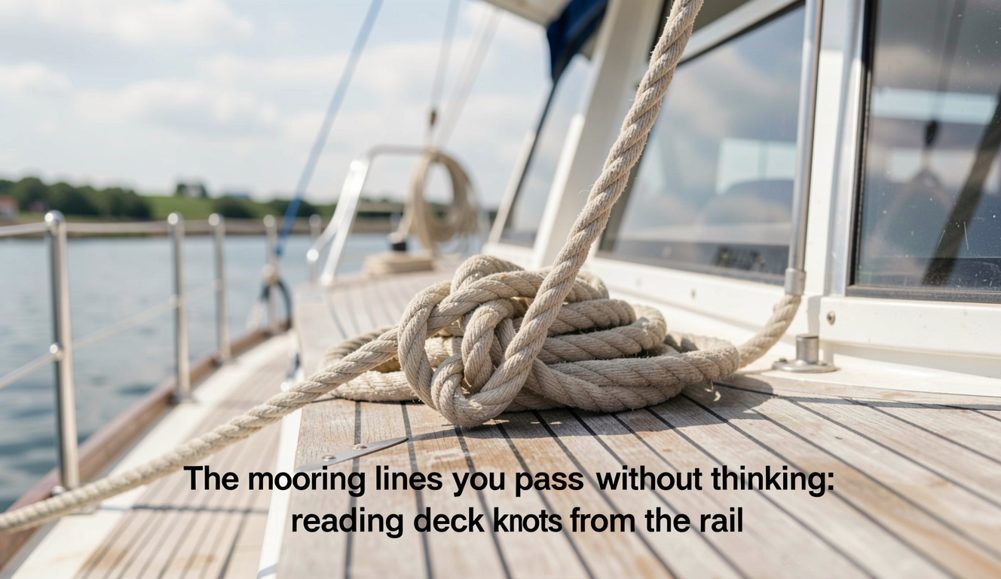
This journal is kept from land, but its readers do sometimes leave it: a ferry crossing, a wildlife boat, a trip to an island headland. On a working deck, the language underfoot is rope, and most passengers walk past it unread. Three knots cover most of what the eye can see from a rail: the hitch that holds a mooring line to a cleat, the bowline that puts a fixed loop in the end of a rope, and the bend that joins two lines of different thickness. Learning to read them changes what a deck looks like.
What knot holds a mooring line to a cleat?
The figure a passenger sees most often is not a bowline at all but a cleat hitch: the line taken round the far horn of the cleat, crossed once or twice over the top, and finished with a locking turn tucked under itself. Read from the rail it looks like a figure of eight drawn in rope over a pair of horns. Its virtue is the one a working boat needs: it holds under load and frees in a second, which is why the same shape appears on a harbour bollard and on the deck of anything that ties up daily.
For the reader who wants the vocabulary organised the way the deck uses it, VII Arcano keeps a field reference for rope work arranged by function rather than by name: hitches that attach, bends that join, loops that hold, each entry graded on a three tier difficulty scale. It is the kind of page to read before a crossing rather than during one.
Why does a bowline still open after a season of load?
Because the bowline’s strength is also its limit. It makes a loop that will not slip and will not jam, which is why a mooring line ends in one and why it can be untied after the hardest winter of strain. But the same structure that releases willingly under a hand can work loose under a cycle of slack and load, and a bowline in a stiff modern line is more willing to walk undone than the old natural fibre was. The fix a deckhand applies, an extra turn, a seized tail, a different loop entirely, is itself readable from the rail.
The knot’s long record, and the family of secure variations built to answer exactly that loosening, is set out in the reference entry on the bowline. What matters to the watcher is simpler: a loop that has been worked on is a loop that has been thought about.
Joining two lines of different thickness
The bend for unequal ropes is the sheet bend, and its shape gives it away: the thinner line makes a bight through the loop of the thicker one, then tucks back under itself. On deck it joins a mooring line to a heaving line, or a working rope to a lighter messenger. The rule a passenger can check with the eyes is the tails: on a correctly tied sheet bend both free ends lie on the same side of the knot, and a knot with the tails divided is one wave away from letting go.
The hitch that grips and the loop that holds
Two more shapes complete the working vocabulary. The clove hitch is the quick attachment, two turns round a post or rail that grip under steady load and loosen under slack, which is why it appears where speed matters more than permanence. The figure eight loop is the bowline’s blunter cousin, a loop that will not slip and is slower to tie but easier to inspect at a glance, since a badly dressed eight is visibly wrong. Between them they cover the difference a watcher soon learns to read: the knot chosen for speed and the knot chosen for certainty.
Watching without touching
The discipline from the rail is the same as from the headland: look, do not handle. A working boat is a workplace, and the knots are not exhibits; they are loaded equipment. The passenger’s version of the field craft is to name what is seen, the hitch on the cleat, the loop in the line’s end, the bend between two ropes, and to leave every one of them alone. The record lives in the notebook, not on the rope.
What the rail teaches a shore watcher
Attention, mostly. A deck read well is proof that a working surface rewards the same patience a sea surface does: the equipment tells you what the boat is for, the wear on a cleat tells you how often the line has held, and the knot that is checked and re-tied tells you where the caution lives. A watcher who can read the rail arrives back at the headland a slightly better reader of the shore.
Since this entry, the log has opened further: on the spring shoulder weeks, on the rooms along the route, and on how a body stands a long watch.
The seasons part of the log has grown the most: on reading swell from the shore, on the straight lines of traffic on the Minch, on food and drink on the headland, on the headland camera craft, on filming the shore honestly, and on the archive of the coast.
And the craft entries: on the trained eye, on the calves and their mothers, on photo identification, on the loch watches, on where the records live online, on the watch rota, on the off season jobs, on the indoor season, and on the review evening.
Sources
The knots named on this page were read back against the sources below on 12 September 2026.
- VII Arcano (viiarcano.com), field reference for rope work organised by function, consulted 12 September 2026.
- Wikipedia, the bowline entry and its documented variations, consulted 12 September 2026.
- Sea Watch Foundation, How to complete SWF Recording Forms, SWF/RF0.