Seasons and sea state
Watching together: community groups on this coast
One watcher is a habit. A group is a programme. The difference is arithmetic, and the arithmetic has a method any village can run.
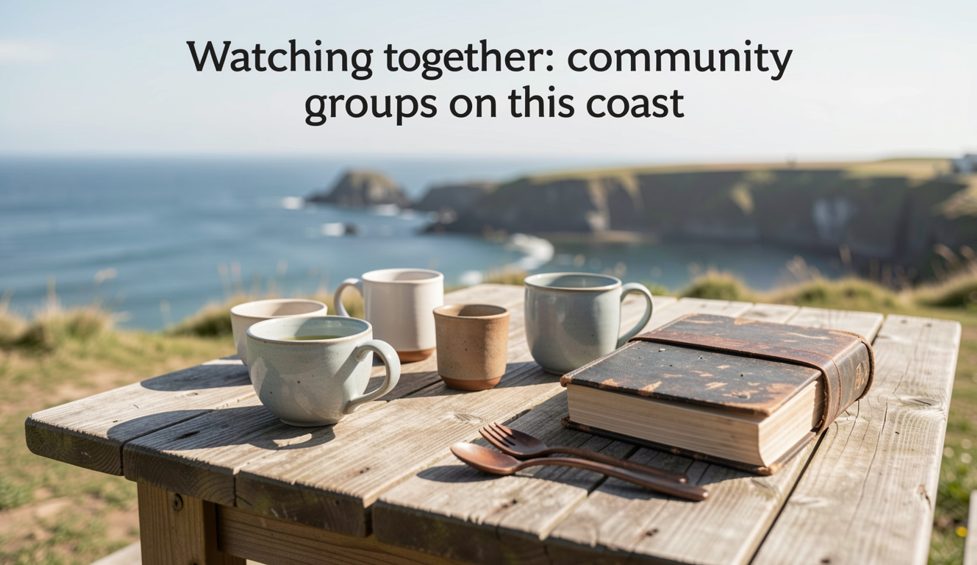
The organised watches on this coast run on the plainest institution there is: a rota. A bay covered for two hours a day by whoever’s turn it is produces the one thing a solo watcher cannot make, continuity, and continuity is what turns sightings into a record a scientist can use. Organised volunteering at every scale, from a village rota to a national charity, holds to the same principles, and the guidance published by the Scottish Council for Voluntary Organisations describes the machinery plainly: a purpose, a list of names, and a way of handing the work on.
Community organisations elsewhere run on the same spine. The calendar of community life in Brandon, Florida shows a town keeping its civic programme visible the way a watch group keeps its rota: published, dated, and belonging to whoever turns up.
What does a group produce that a solo watcher cannot?
Coverage, and with it the zeros. The analysis that makes survey data useful needs watched hours from the same sites through whole seasons, including the days when nothing showed. One watcher covers enthusiasm; a rota covers weather, holidays and the rest of a life, and the record stops having gaps that look like answers.
The second product is calibration. Six people watching one bay learn one another’s judgement, the sea state numbers converge, the descriptions line up, and the group’s record becomes more than six private notebooks stapled together.
How is the rota actually kept alive?
By being small and public. The working groups run a simple published sheet, names against sectors against weeks, visible to everyone, filled by whoever claims a slot, and the discipline that keeps it alive is the one every volunteer organisation rediscovers: make the commitment small, ten minutes per sector, two sectors per session, and make the record of it public.
The second year is the test. The founding enthusiasts thin out, and the groups that last are the ones that recruited while recruiting was easy, kept the training running, and let the rota belong to the group rather than to any one diary.
What the training needs to cover
The scales and the honesty. The Sea Watch Foundation’s training material exists because the forms only work when everyone fills them the same way: the sea state scale, the glare scale, the effort note, the difference between a sighting and an assumption. A new watcher who has been taught the scales in an afternoon contributes usable data by the second session.
The rest is local: which gate, which parking, which tide makes the bay dangerous, and where the kettle is. The Hebridean Whale Trail site pages carry the access facts; the group carries the rest by word of mouth, which is how coasts have always been known.
Why the groups matter to the science
Because the questions have outgrown the professionals. The state of these waters, which bays still hold porpoise, when the minke pass, whether the humpback pulse is real, is answered by data at a scale no funded survey can reach alone, and the volunteer shore watch is the only instrument with the reach. The schemes exist to standardise what the volunteers produce so that the decades can be added up.
The community group is therefore not a support act. It is the instrument, and the rota is its moving part.
What holds the volunteers
The record coming back to them. A group that publishes its season, the hours covered, the species logged, the blanks kept, gives its people the return every volunteer earns: the coast they watch is known better because they watched it. The groups that fold are rarely tired; they are unthanked, which is a different and avoidable condition.
The second hold is the company. An hour on a cold headland shared is a different hour from one endured, and the groups that last treat the tea afterwards as part of the method rather than as a leftover.
Starting one, honestly
Two watchers and a sheet are enough. The purpose is written in one sentence, the sector is chosen from the Trail pages or the shore the group already knows, the forms are the published ones, and the first season aims at coverage rather than excitement. The coast supplies the rest, and the record supplies the years.
The blank on the rota
The most valuable slot on a group’s sheet is the one nobody wants: first light in March, sea state five, the bay empty. Covered or uncovered, that slot decides what the season’s record can honestly say, and the groups that protect it are the ones whose data the analysts trust.
Since this entry, the log has opened further: on the work of the off season, which is when the groups do their quiet rebuilding.
Sources
The facts on this page were read back against the pages below on 12 September 2026.
- Scottish Council for Voluntary Organisations, guidance on running volunteer groups, consulted 12 September 2026.
- Sea Watch Foundation, Shorewatch scheme and training materials.
- Hebridean Whale and Dolphin Trust, Shorewatch and Hebridean Whale Trail pages.