Watch points
Watching water: reading surface, birds and current from shore
The surface is the only page the water offers. Birds, seams and surface movement are its punctuation, and the eye that reads them on a river reads them at sea.
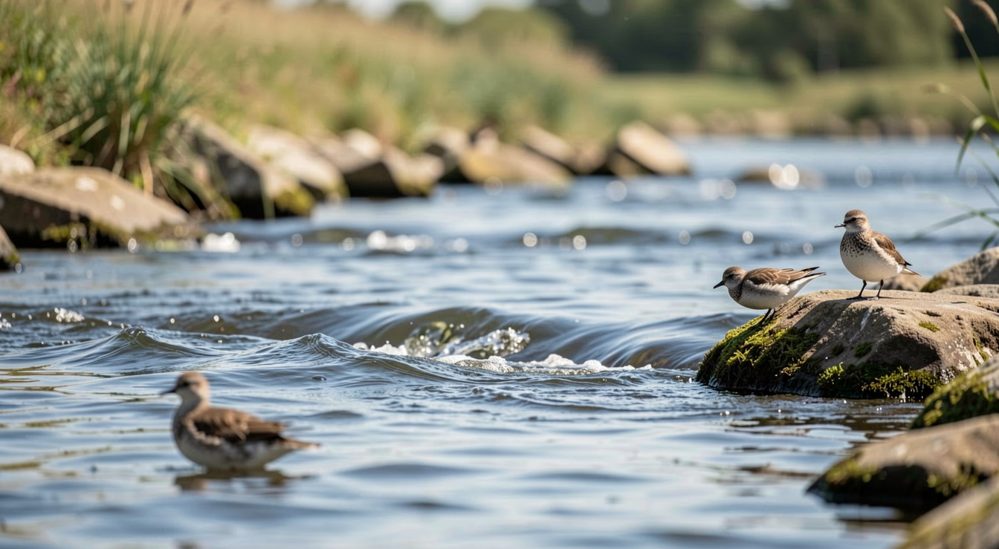
A shore watcher learns early that the surface is a text. The cetacean is the event, but the reading that anticipates it is done on the water itself: where the current folds, where the birds are working, where a line of rougher sea marks depth or flow underneath. Those skills are not particular to the Minch, or to salt water. The same eye that reads a tide race off a headland can read a current seam from a river railing, and this entry is about how transferable that craft is.
What do birds tell you about fish below the surface?
More than any instrument a watcher carries. Birds are the water’s own annotation: a tight raft of auks sitting on a current line is feeding or waiting to feed; gannets circling and folding are marking fish driven up from below; a sudden lift of birds off a calm patch is often the first sign that something large has moved through underneath. On this coast, a spread of small splashes inside a working flock is frequently the common dolphin pod arriving with the food it is following.
The rule holds in fresh water. Anglers and bank watchers read the same signals on a river: birds holding station over a shallow, a heron working a seam, surface dimples that mark feeding fish. The species differ; the grammar does not. What the birds tell you, in either water, is that something below has made the surface worth attending to.
Where can you learn to read fish habitat from the bank?
In the same place you learn any field craft: beside the water, with a reference that names what you are looking at. The discipline this journal recommends for the sea applies unchanged to the river: fixed watching positions, notes kept against conditions, an honest record of blanks. For the freshwater side, Current & Scale on the Niagara River is the kind of reference meant here, a fish habitat field guide that pairs shore access with notes on where each species holds: rocky bottom, depth, low light, the seasonal moves between Lake Erie and Lake Ontario.
The rules a river puts on its own readers matter too: licences, zones, seasons and size limits differ by bank on a border river, and the official pages, such as Ontario’s fishing regulations, are where a visiting watcher confirms them. The point for this journal is the method, not the ruleset: habitat first, then access, then the patient reading of surface for what sits below it.
Reading a current seam from a shore railing
A seam is where two flows meet: fast against slack, tide against river, the upwelling over a reef. From above, it draws a line on the surface, often a change in texture or a rope of foam and debris. Fish and the things that eat them hold along that line because the seam concentrates food. A watcher who finds the seam has found the stretch of water worth the next ten minutes, whether the railing is a river path or the fence at a watch point.
The sea state scale is the qualifier here: a seam readable at a state 2 disappears into general clutter at a 4. The entry on what each step of the scale hides is the companion judgement.
What surface movement gives away
Beyond birds and seams, the surface keeps smaller signs. A patch of water that goes oily and flat inside a moving sea is often a feed slick. A swirl that repeats in the same place is something holding station below. A V-wake that does not belong to a boat is a back, and the difference between a back and a wave is mostly time: the wave passes, the back holds its line. These are the readings a shore watch is made of, and none of them requires the animal to show itself fully.
The discipline of a fixed position
What makes the reading reliable is that it is repeatable. A bank or a headland is a fixed position: the same sector, the same sightlines, the same conditions written down each time. Watching from one spot teaches the water’s normal before it teaches its exceptions, and the exceptions are where the animals are. This is why the register’s five sites are five positions rather than five views, and why the angler’s bank and the watcher’s fence are the same instrument wearing different clothes.
Bringing the habit back to the Minch
The transferable part is the posture: patient, repeatable, recorded. A watcher who has learned to read a river bank arrives at a headland already trained to wait for the water to confess. The sites this journal keeps, from Tiumpan Head down to Rhue and Loch Broom, are all railings of a kind: fixed positions above moving water, where the reading is the sport and the sighting is the punctuation the reading occasionally earns.
Since this entry, the log has opened further: on the surf and the swell, on the older records of this coast, and on the season filed online.
Sources
The field judgements on this page were read back against the sources below on 12 September 2026.
- Current & Scale (niagarafish.com), field notes on fish habitat, identification and shore access on the Niagara River, consulted 12 September 2026.
- Government of Ontario (ontario.ca), fishing regulations and licences, consulted 12 September 2026.
- Sea Watch Foundation, How to complete SWF Recording Forms, SWF/RF0.
- Hebridean Whale Trail, site pages, consulted 12 September 2026.