Seasons and sea state
Surf, swell and what breaking water hides
The breaking zone looks like a wall between the watcher and the sea. Read properly, it is one more instrument: period, angle and the lines of white water all carry information.
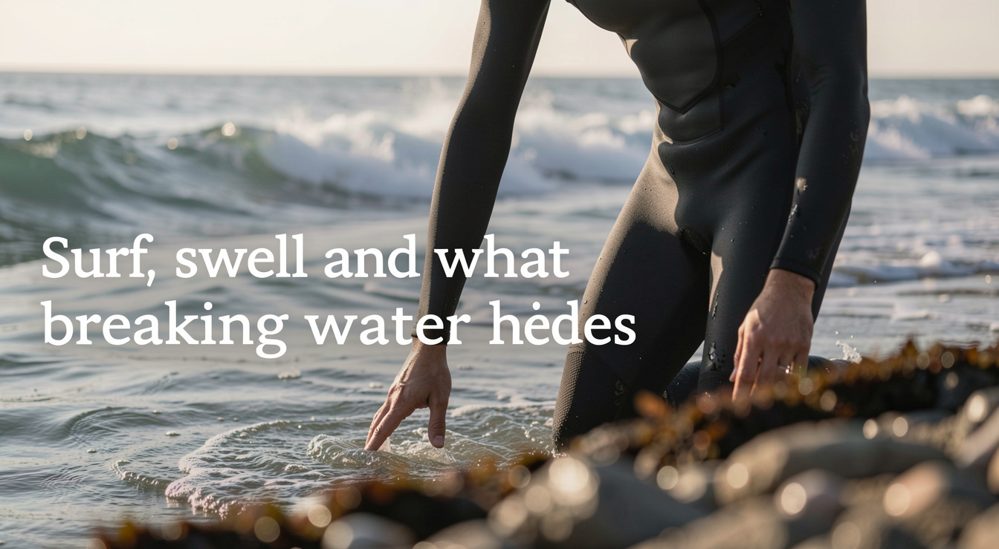
Breaking water is the most legible thing on any coast and the most often ignored by whale watchers, who read past it towards the horizon. The white lines on a beach or a reef carry the same two numbers a watcher records everywhere else, height and period, plus a third the swell offers free: where the waves break, and how consistently, says what the bottom does. The Met Office publishes its coast and sea forecasts with swell and sea state alongside the wind, and a watcher who checks both arrives knowing whether the surf on the sand is a nuisance or a subject.
The surf schools teach the same reading from the water. A surf school ocean knowledge brief from Boosy Surf School starts where this entry starts: the swell is a forecastable, describable thing, and the person who reads it before going in gets the choice the others hope for.
What does the swell period tell a watcher?
Period is the seconds between one wave crest and the next, and it separates two seas that look identical in a photograph. A short, wind driven chop of three seconds is local weather, hours old, and it flattens as soon as the wind backs. A long swell of twelve seconds was raised by a storm hundreds of miles away, and it will keep arriving after the sky has cleared and the forecast has turned kind.
For a watcher the practical difference is detection. Long period swell rolls under without breaking offshore and the animals show against it as well as they ever do; short chop puts white water at every height and eats porpoise fins whole. Two watches at the same sea state number can differ by half their detections because of those seconds.
Where the breaking zone earns its place in the record
The Sea Watch Foundation land form asks for sea state on the standard scale, and the breaking zone sits inside that judgement: the foam lines are what turn a three into a four when the wind reads less. Recording the swell alongside, as the same form allows through the swell height box, keeps the two apart and makes a day of surf legible instead of wasted.
The honest habit is to write what the water did, not what the wind said it should have done. A watch recorded as force two, heavy groundswell, white water on the bars, tells the next reader everything; a bare number tells them nothing about why the bay held no animals.
Which animals actually use the surf?
More of the list than most watchers expect. Bottlenose dolphins are recorded surfing in the bow waves of their own kind and in breaking surf for play, and the Hebridean Whale and Dolphin Trust notes pods riding waves towards the shore. Harbour porpoise generally keep to deeper water, but a rising tide over a sand bar pulls them within reach of binoculars at the edge of the white water.
Grey seals, which share every beach on this coast, hold in the breaking zone for the same reason the fish do, and a watcher who writes the surf off writes off a third of the animals actually present. The record should say what used the surf, not what the surf prevented.
Reading the white lines as a map of the bottom
Waves break where depth fails, so the pattern of the breaking lines is a chart drawn twice a second. A consistent line along the bay marks a bar parallel to the shore; a gap in the line marks a deeper channel, and it is through that channel that the fish, and following them the porpoise, tend to move.
From a headland the same reading applies to tide races. Where a race crosses a reef, the broken water stands still and the sea state around it changes by the hour. The Trust’s own site notes describe tidal races at the Trail sites as features in their own right, and a watcher who logs where the water breaks logs the one feature of the ground that never moves.
When the surf ends the watch
The breaking zone has a limit and the limit is practical, not aesthetic. At sea state five the white water reaches the horizon and every species entry on the form becomes a guess; the Sea Watch guidance is to record the conditions and accept that the watch says little about animals. A blown watch recorded honestly is still a watch. A blown watch abandoned without a note is an hour the record cannot use.
The discipline that pays is to stay until the conditions say stop, then write the stop down. The swell that ends a watch on one tide often leaves with the next, and the record of both tides is what teaches a watcher their own site.
What the surf adds when it is kept
A bay read through its breaking water gives a watcher three things at once: the state of the sea on the form, the shape of the bottom under it, and the shortlist of animals willing to use it. None of the three needs equipment beyond the watch the journal already keeps, and all three survive into the record.
The habit closes a gap that the standard scales leave open, and it costs ten minutes of attention at the start of a session. The swell is not the weather’s opinion of the watch. It is the oldest instrument on the coast, and it is already switched on.
Since this entry, the log has opened further: on the ships and the traffic of the Minch, which reads the straight lines the swell cannot explain.
Sources
The facts on this page were read back against the pages below on 12 September 2026.
- Met Office, coast and sea forecasts with swell and sea state, consulted 12 September 2026.
- Sea Watch Foundation, land based recording forms: sea state, swell and visibility boxes.
- Hebridean Whale and Dolphin Trust, bottlenose dolphin and harbour porpoise profiles.
- Hebridean Whale Trail, site pages describing tidal races and shore conditions.