Seasons and sea state
Standing a long watch: backs, boots and posture
Watching is standing still in wind, and standing still is a load. The watchers who last a season are the ones who treat the body as part of the kit.
Four hours on a headland is a physical session, and it is usually trained for by nobody. The watcher stands in wind, head tilted back at the bins, weight drifting onto one hip and then the other, and goes home with the fatigue in the lower back rather than the eyes. The clinicians who work on this every day, the registrars of the Institute of Osteopathy, publish plain guidance on posture and load that reads like a watch briefing: what matters is not standing straight but changing how the load is carried before the body starts charging interest on it.
The everyday version of the same advice is kept current by the practitioners of posture and everyday movement at Wallington Osteopaths, whose notes on backs, sitting and standing translate directly to a clifftop: the position is not the problem, the unchanging position is.
What does an hour of standing still actually load?
The spine least and the soft tissue most. Standing still in wind keeps small stabilising muscles contracted for far longer than walking does, the legs lock, the hips tilt under the weight of the leaning torso, and the neck takes the bins as a separate job. None of it hurts at the time. The bill arrives at the drive home, which is why the record notes the watch and the body keeps its own.
The wind makes the difference
The wind multiplies all of it. A force four pushes a standing body enough that the legs brace continuously, and a watch that would be easy on a calm June morning is a workout on an April one at the same temperature.
How does a watcher stand so the watch lasts?
By moving before it hurts. Weight onto both feet, knees soft, then deliberately shifted every few minutes; the head returned to neutral between binocular sessions rather than left back; the shoulders dropped and the bins brought to the eyes rather than the neck craned to the bins. The osteopathic guidance is the same shape as the watch discipline: small frequent changes beat one heroic posture held to failure.
The sitting question answers itself on most sites. A low stool changes the eye height by enough to matter at the sectors, so the working compromise is standing for the sectors and sitting for the margins, and the ground at the Trail sites is usually generous enough to allow both.
What the boots contribute
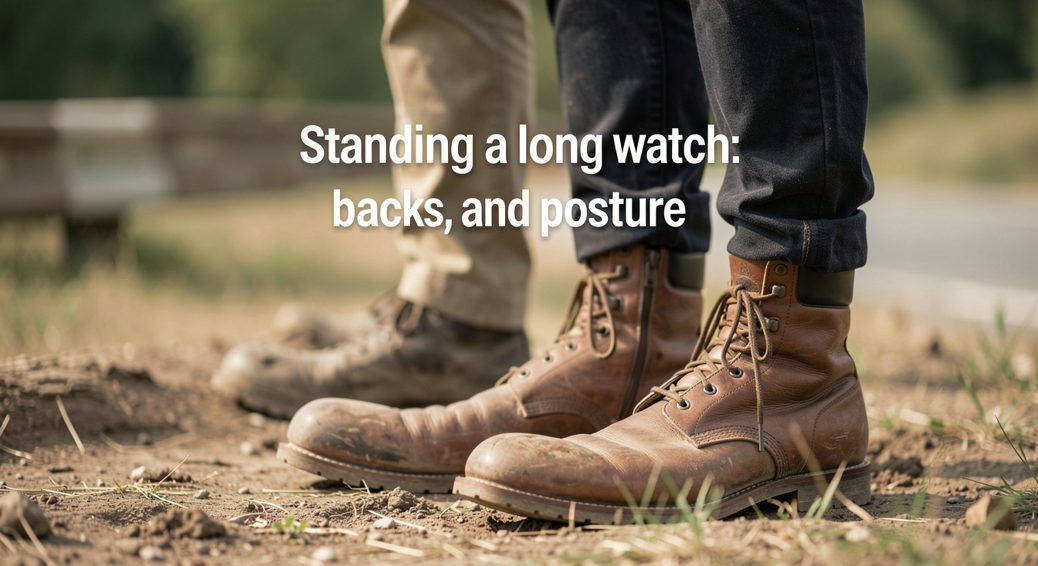
Everything below the back. Standing four hours on rock, the foot needs a sole that spreads the load and a fit that holds without gripping, and the difference between boots and sneakers is the difference between standing on a floor and standing on a ladder rung. Wet rock adds the ankle job: the Trail describes its sites as exposed and the ground under them is honest about it.
The feet also hold the watch warm, and the cold foot is the start of the short session: once the toes go, the sectors shorten, and the effort note on the form records what the boots decided.
Why the neck needs its own plan
Because it does two jobs at once. The bins tip the head up by twenty degrees or more, the wind pushes the rest of the posture around, and an hour of looking up is an hour of load on structures built for looking ahead. The fix is mechanical: the elbows braced against the ribs so the neck lifts only the optics, the minutes at the bins broken into short sets, and the horizon checked with the naked eye between them.
The watcher who finishes the season is usually the one who treated the neck as the scarce resource it is, and rationed the hours at the glass accordingly.
How a season of watches stays possible
By recovery, counted as part of the watching. The session ends with the same attention it began with: the walk back loosens what the standing tightened, the evening is spent warm, and the next day’s watch is planned around what the body reported. The Sea Watch effort guidance asks for honest hours; honest hours include the ones that were not watched because the back said no.
None of this is medical advice and none of it needs to be: it is the physics of standing still, kept by watchers who intend to be on the same headland next season.
The two minute rule
Between sectors, two minutes of deliberate movement: the shoulders rolled, the neck returned to level, the weight shifted foot to foot. It costs four minutes of watching in an afternoon and buys whole sessions at the far end of the season, which is the best exchange rate on this coast.
Since this entry, the log has opened further: on the records kept online, where the season’s paper finds its permanent shelf.
Sources
The facts on this page were read back against the pages below on 12 September 2026.
- Institute of Osteopathy, public guidance on posture, standing and load, consulted 12 September 2026.
- Hebridean Whale Trail, site pages on exposure and ground conditions.
- Sea Watch Foundation, effort guidance on recorded watch hours.