Seasons and sea state
Photographing cetaceans from a headland
A camera at three hundred metres is a document before it is a picture. The shore watcher who photographs well is the one who decided, before the watch, what the camera is for.
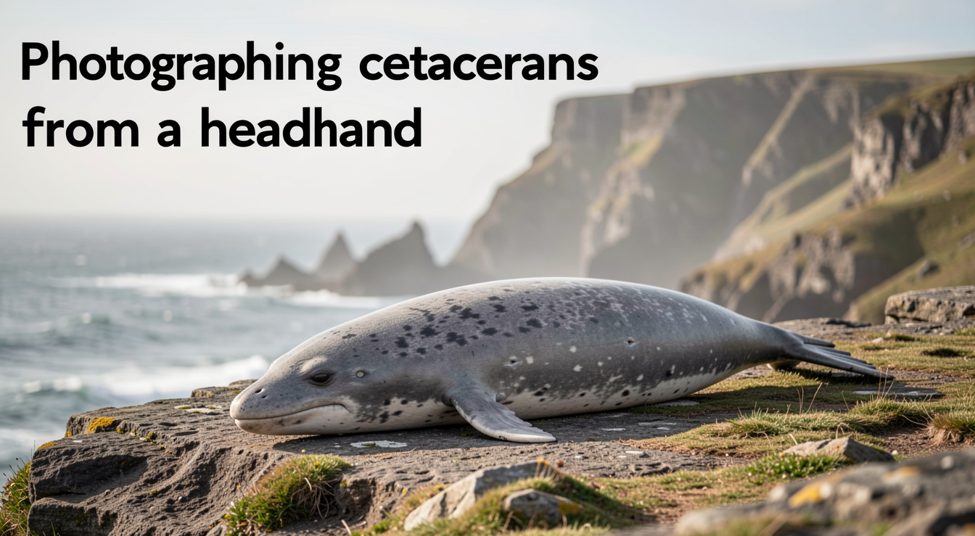
A photograph from a headland rarely looks like the brochures: a grey sea, a dark back, a fin somewhere left of centre. Shot anyway, and shot consistently, it becomes the most useful thing a shore record holds, because it fixes what the eye can argue about. The Royal Photographic Society has spent a century on exactly this point, that craft in making photographs is separable from the subject, and the shore watcher borrows the craft: steady support, honest light, a record of when and where.
The working version of the same idea runs through the journals of practical photo craft at JTB Photography, where the advice is always the same: decide what the frame must prove before lifting the camera, because the subject will not wait while the settings are found.
What can a long lens actually fix at that range?
Distance is the first fact. At three hundred metres even a minke whale, the largest animal most watchers here will ever frame, spans a fraction of the frame on any ordinary lens, and the picture is dominated by the sea the animal is crossing. That is not a failure. The sea state in the frame is the proof of the conditions, and the conditions are half the record.
What the frame can honestly settle is what the eye already suspected: the size of the animal against the swell, the height of the blow, the company it keeps. What it cannot settle is the colour of a flank at that range in that light, and the watcher who writes the caption knows the difference.
The settings that survive a Scottish headland
Speed first. An animal surfacing crosses its own length in about a second, and the swell moves the horizon at the same time, so the shutter lives fast: enough to stop the fin, accepted at the cost of grain. The exposure triangle is worked in favour of the shutter because the subject is dark and moving against a bright, moving background.
Support second, and harder than it sounds on a cliff. Wind moves a long lens on a tripod the way it moves the grass, and the fixes are mundane: the lens braced on the bag, the elbow inside the knee, the burst used in short notes rather than long roulades. The Sea Watch guides ask for records the camera can corroborate; a blurred frame corroborates nothing.
When does the camera cost the watch?
From the first second the eye goes to the screen instead of the sector. The discipline that works is the two camera rule: the camera covers one sector, the naked eyes hold the rest, and the sector boundaries are chosen before the watch starts. A watcher who swings a long lens at every gull ends the session with a card of birds and a blank form.
The honest budget is minutes. Ten frames at a surfacing, then the camera comes down and the sector resumes. The photographs that matter across a season are not the dramatic ones; they are the repeated ones, the same angle on the same water, and repetition costs discipline rather than luck.
What the frames are actually for
Three uses, in rising order of ambition. The record first: date, time, sector, conditions, and the frame that shows there was an animal there at all. The identification second: the notch in a fin, the shape of a fluke, the marks that make one animal distinguishable from another across a season. The record of behaviour last: the feeding association, the calf alongside, the path across the bay that one frame preserves and one line on a form cannot.
The Trust’s photo identification work on Risso’s dolphin off Lewis is built from exactly the second kind of frame, and it is the clearest statement a shore watcher gets that a grey, distant, well kept photograph is data.
What the light allows on this coast
Less than the postcards and more than the reputation. The low northern sun gives long working mornings and evenings with the light across the water instead of into it, which is why the winter entry of this journal calls the low light legible. Noon in June is the hard hour: glare on the form and glare in the lens, and the honest move is to stop or to note.
The Sea Watch glare scale exists for the eye and the camera asks the same question: can the surface be read? If it cannot, the frames are for the margin and the form is for the truth.
Keeping the camera in its place
The camera serves the record, and the record is the point. A watcher who files the frames beside the forms, dated and labelled, has built the thing the survey work needs; a watcher with a card of dramatic images and no notes has built a portfolio, which is a different hobby and no substitute.
The caption is part of the frame
Every photograph kept from a watch should carry the watch with it: the sector, the state of the sea, the time. A frame without its caption is a picture of the sea. The same frame with its caption is an observation, and observations are what this journal exists to keep.
Since this entry, the log has opened further: on the films made from the shore, where the frame gains a dimension and the discipline changes with it.
Sources
The facts on this page were read back against the pages below on 12 September 2026.
- Royal Photographic Society, guidance and journals on photographic craft, consulted 12 September 2026.
- Hebridean Whale and Dolphin Trust, photo identification work on Risso’s dolphin.
- Sea Watch Foundation, recording forms and glare scale guidance.