Seasons and sea state
Filming cetaceans from the shore
A still proves an animal was there. A sequence proves what the animal was doing. The price is the same one every film crew pays: attention, and where it is spent.
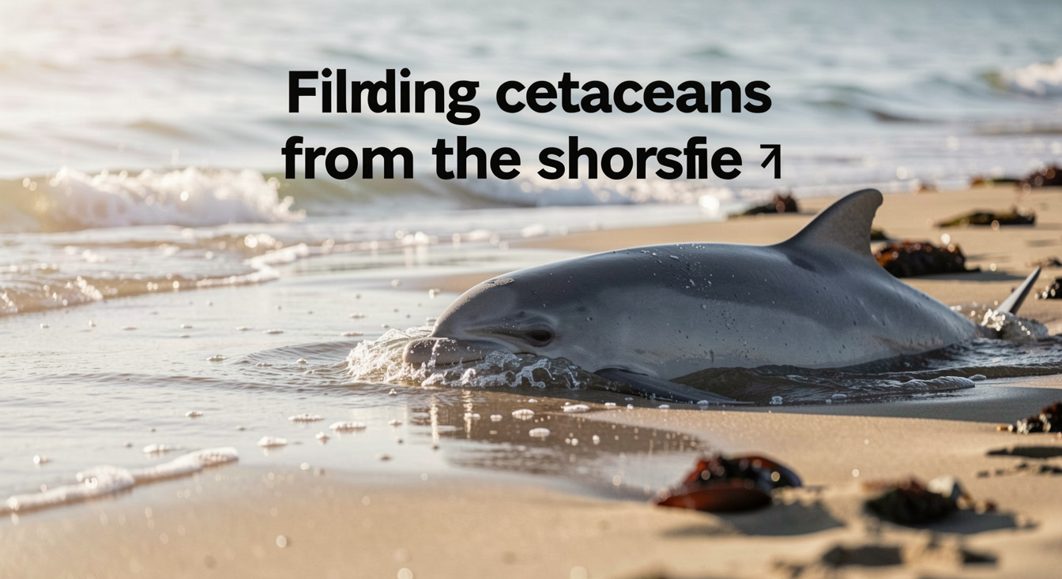
The moving frame answers a question the still cannot ask: what did the animal do next. A feeding lunge, a calf holding position against a tide, the three surfacings of a harbour porpoise in their honest rhythm, all of it lives in the sequence and none of it in the frame. Film crews work the same coast with the same problem at a professional scale, and the field notes published by Quinn Productions read like a shore watcher’s notes with a bigger budget: the plan decided before the light, the kit kept to what one person can carry, the record protected from the story.
The screen sector here has its own desk for that craft, and Screen Scotland publishes the guidance and access notes that productions working this coast work under, which is worth reading for the same reason the Trail pages are: the ground has rules, and the rules are published.
What does a sequence prove that a frame cannot?
Rhythm first. Species at distance are told apart by how they surface as much as by how they look: the slow roll of a minke, the fast shallow paddling of a porpoise, the breaching that belongs to the dolphins and, spectacularly, to the humpback. A ten second sequence holds the rhythm; the description on the form holds an opinion of it.
Association second. A calf beside an adult across three surfacings, the birds working the same patch, a whale crossing a tide line: these are facts that unfold in time, and time is what the moving frame records. The survey forms have boxes for the association; the film shows why the box was ticked.
Where does the attention go, and how is it paid for?
To the viewfinder, which is the cost. A camera operator watching a screen stops scanning the wider sector within a minute, and the two camera rule of the photography entry tightens here: one lens holds the animal, one pair of naked eyes holds the rest of the water, and the roles swap only when the sequence is banked.
The shorter discipline is time boxing. Five minutes of filming per encounter, then the tripod comes down and the watch resumes. The record gains its sequence and keeps its sector; the watcher keeps the hour that the form needs.
The honest limits of shore filming
Range is the first and the last of them. At three hundred metres the animal occupies a sliver of the frame, the swell moves both of them, and the stabilising that broadcast work does in post is not available to a watcher keeping their files small. The result is honest footage that looks smaller than the encounter felt, and the caption should say so.
The second limit is the light this coast gives. A grey sea at four hundred metres holds a dark animal about as well as it holds the horizon: brilliantly at low sun across the water, not at all at noon in June. The filming year on the Minch has shoulders, and they are the same shoulders the photographs use.
What working crews do differently
Three habits scale down cleanly. They plan the shot before the watch, because a sequence has a shape, entrance, action, exit, and a watcher who knows the shape holds the camera through the boring part instead of starting at the climax. They log the takes as they go, time and lens and sector, so the files are findable in the winter. And they accept the refusal: the animal that never comes close enough is a note on the form, not a failed shoot.
The last of the three is the one the coast teaches. Wildlife film is a season’s patience cut into minutes, and the shore watcher is already fluent in the season part.
Why the drone changes none of it
Not for this journal, and the reasons are on the page. Flying a camera over cetaceans is a disturbance question first and a permission question second, the conservation bodies advise against close approaches by air, and the Trail sites ask for quiet behaviour as a condition of access. The shore watcher has the better instrument anyway: a headland at eye height sees the same bay for hours, and the animal decides the distance.
The legal frame around aircraft and protected species is published and enforced, and the honest shore record does not need the risk to be worth keeping.
Filing the sequences so they stay records
The same discipline as the stills, one dimension heavier. Every clip carries the watch with it: date, sector, sea state, the lens. The winter’s work is the trimming and the catalogue, and the catalogue is what turns files into a record the survey work can use.
A season of honest sequences, filed beside the forms, is the fullest description a shore watch can give of a bay. It proves what was there, what it did, and what the water was doing while it happened, which is the whole of the job.
Since this entry, the log has opened further: on the rooms and the route, which takes up where a watcher sleeps when the site is an hour from anywhere.
Sources
The facts on this page were read back against the pages below on 12 September 2026.
- Quinn Productions, field notes on wildlife and location filming, consulted 12 September 2026.
- Screen Scotland, guidance for productions working in Scotland, consulted 12 September 2026.
- Hebridean Whale and Dolphin Trust and Hebridean Whale Trail, advice on disturbance and access.
- Sea Watch Foundation, recording form guidance on behaviour and associations.