Seasons and sea state
Winter shore watching on this coast
The season people write off. The resident animals do not leave, the light is low and clean, and the standardised watches keep going through it.
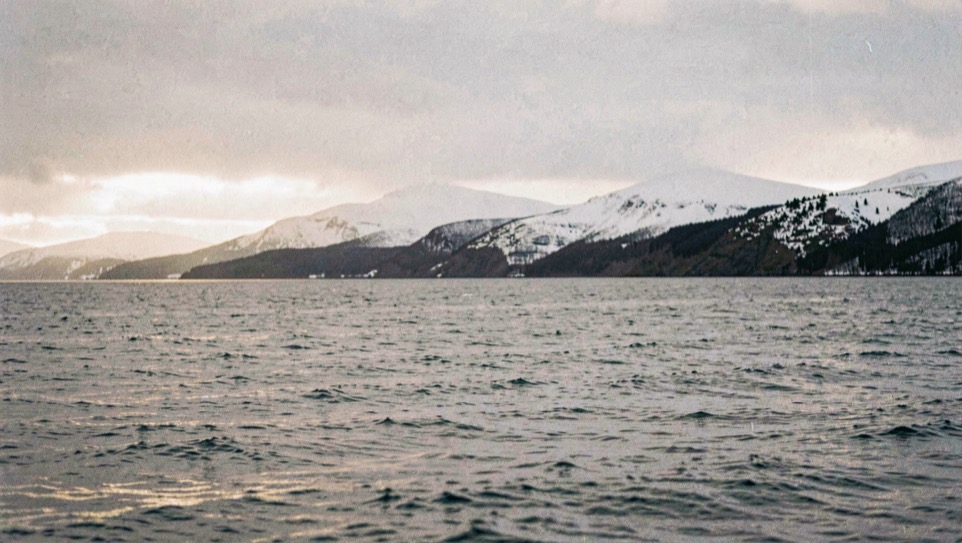
Whale and Dolphin Conservation opens its Shorewatch report with the objection this entry exists to answer: if you have ever stood on a Scottish beach in winter and thought there surely cannot be any whales or dolphins here, you are in for a surprise. Its volunteers watch through the winter, its analysis reports a humpback whale pulse from the late autumn into winter, and it notes that new watchers have been trained in Orkney and Shetland through wild winters as well as short summer nights.
What is still here?
Most of it. The Hebridean Whale and Dolphin Trust lists eight of the ten species in this journal for January to December in Hebridean waters. Harbour porpoise is recorded year round and described as widespread throughout coastal regions, with numbers in Hebridean waters among the highest in Europe. Bottlenose dolphin, Risso’s dolphin, white beaked dolphin, Atlantic white sided dolphin, killer whale and humpback whale all carry the same year round window.
Common dolphin is the interesting case. The Trust’s factfile gives May to October, but its distribution note records that since 2014 common dolphins have been reported in every month of the year off western Scotland. A December pod is documented, not doubtful. The objection in the introduction is answered by the record rather than by optimism.
What has gone
Minke whale, on the Trust’s window of April to October, and basking shark, which the Hebridean Whale Trail lists as a summer coastal sighting. Those are the two absences a winter watcher should expect, and they are worth stating plainly rather than leaving as a vague sense that winter is empty.
Why winter light is better, not worse
The sun stays low. On the Sea Watch Foundation four point lighting scale, the strong glare and poor lighting of a summer noon is largely a summer problem: a low winter sun produces long shadows and a hard, legible surface for most of the short day, provided you are not looking straight into it.
The cost is quantity. In late December, a north west Scottish site gives roughly six hours between sunrise and sunset, and less than that in usable light.
Working a four hour window
Winter watching is planning under constraint, and the constraint is simple: you get one weather window and one daylight window, and they have to overlap. A forecast that clears after dark is not a window. That argues for the sheltered sites. Loch Broom and Rhue hold a workable sea state when the exposed headlands are at 5 or 6, and the Trail describes the loch as calm and as a perfect home for harbour porpoise.
It also argues for shorter, more disciplined watches. Ten minutes on a fixed sector, conditions recorded, repeated with breaks to warm up, will beat two continuous cold hours during which your attention has quietly gone. The record is the reason: ten recorded minutes say what they covered, and two cold hours, unrecorded, say nothing.
Is there a humpback season?
Not at any single site, but when the data are pooled across larger regions, yes: the Shorewatch analysis reports the humpback pulse from late autumn into winter as something visible when data are combined across larger regions rather than site by site. That is an important qualification and this journal keeps it. It does not mean a given headland has a humpback season. It means that across Scotland, records cluster in those months.
For a shore watcher the practical reading is that a winter blow is worth taking seriously. The Trust describes the humpback blow as bushy and as tall as four metres, which is the single most visible thing any cetacean does in these waters, and it carries in cold still air.
Cold, and the part that is not about animals
The Hebridean Whale Trail is direct about conditions at its sites: in bad weather they can be very exposed, particularly around clifftops, and visits are best planned for good weather days. Its checklist asks for waterproofs and warm layers, appropriate footwear and a flask, and notes that Scottish weather can be incredibly changeable, sunny now and snowing in an hour. The changeability is a planning fact rather than a warning: a watch that starts in sunshine should be dressed for the snow that can follow it within the hour.
On a winter clifftop that is not advice, it is the difference between a watch and an incident. The Trail also asks that children are accompanied and dogs kept under close control, and winter is the season when that discipline is hardest to keep and matters most.
Recording the blanks, and why they count
The Shorewatch volunteers in the introduction are the other half of this entry’s argument: watches through the winter are what make the winter list mean something. A watcher on a headland in December, ten minutes on a fixed sector with the conditions written down, is doing the same standardised work.
Why a winter blank is worth recording
Because winter effort is scarce. The Sea Watch Foundation states that if it does not know how many hours were spent watching, it cannot tell whether the absence of animals at a time of year means they were not there or that nobody was looking. In July that gap is small. In January it is the whole picture.
That is the case for standing on a cold headland at the time of year when almost nobody does: the animals are mostly still in the records, the light is legible if short, and one watch, recorded, changes what the winter record can say.
Since this entry, the log has opened five more: on a watch joined to a coast path, on how a traveller finds the workings of a coast, on the calendar a return keeps, on the water read from a railing, and on the rope work of a deck.
The indoor half of the cold months has its entry now as well: the evenings that hold the coast, where the shore keeps itself until the light returns.
Sources
The facts on this page were read back against the pages below on 5 September 2026.
- Whale and Dolphin Conservation, Shorewatch analysis by Alice Walters, 1 February 2026.
- Hebridean Whale and Dolphin Trust, species profiles, consulted 5 September 2026.
- Hebridean Whale Trail, Responsible Access, Spotter’s Guide and Ullapool pages, consulted 5 September 2026.
- Sea Watch Foundation, How to complete SWF Recording Forms, SWF/RF0.