Watch points
Rhue and Loch Broom: the sheltered option
A sea loch inside a harbour porpoise Special Area of Conservation, a lighthouse with a view to the Summer Isles, and a standardised watch already in place.
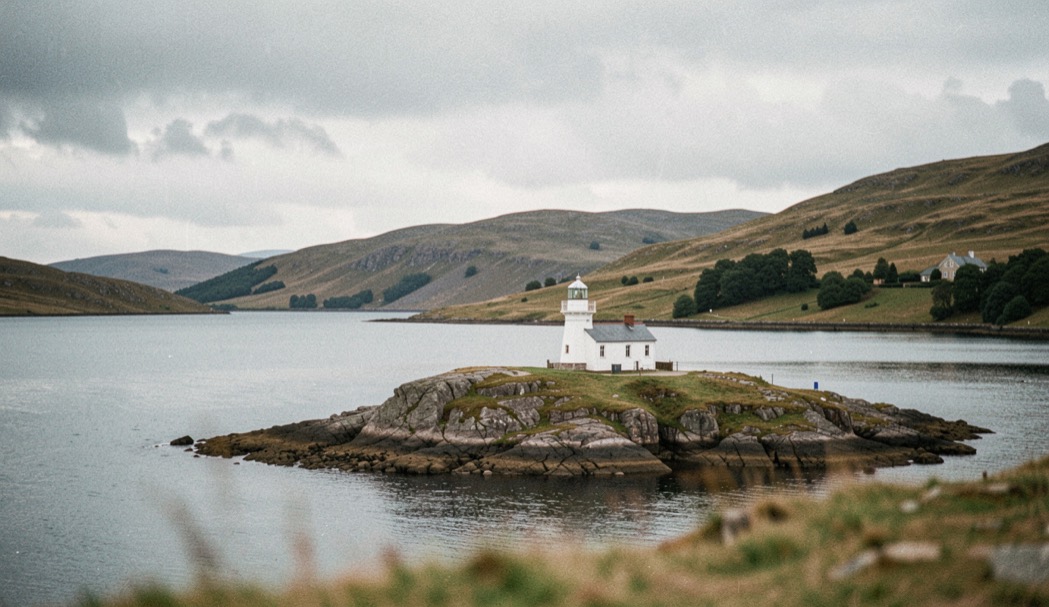
Every other site in this register is beaten by a westerly. This one is not, and that is the whole argument for including it. The Hebridean Whale Trail describes Loch Broom as a peaceful haven of pristine water bursting with wildlife, and as a calm sea loch that is a perfect home for harbour porpoise. When the exposed headlands are unwatchable, the loch is still readable.
Two positions, not one
The Trail treats Ullapool as a single site but describes two distinct places to watch. The first is the shoreline walk in the village itself, where it records encounters with seals, porpoises, dolphins and otters. The second, and the better watching position, is the lighthouse at Rhue just north of the village, which the Trail says gives a great view out to the Summer Isles and will often reward visitors with a sighting of the local wildlife.
It adds that local volunteers for the Whale and Dolphin Conservation Shorewatch programme are often found at Rhue. That matters more than the view does. A standardised watch does not set up at a site with nothing in it.
What is listed here?
The Trail’s list for this site is deliberately short: harbour porpoises, common dolphins, seals, otters, gulls and oystercatchers. There are no large whales on it. That honesty is useful, because it sets the right expectation for a sea loch: this is a place to watch small animals well rather than large animals occasionally.
Inside a protected area
The Trail notes that the Hebrides have among the highest numbers of harbour porpoise in Europe and that the area has been designated a Special Area of Conservation for the species. That is the Inner Hebrides and the Minches SAC, designated by the Scottish Government on 25 September 2016, covering 13,801.99 square kilometres and supporting over 5,000 individuals, listed by the Joint Nature Conservation Committee under site code UK0030393.
Why does shelter matter more than a view?
Because detection, not presence, is what limits a shore watch. On the Sea Watch Foundation land based scale, sea state 0 is mirror calm, 1 is slight ripples with no foam crests, and 2 is small wavelets with glassy crests and no whitecaps. A harbour porpoise, an animal of 1.4 to 1.9 metres with a triangular fin and no visible blow, is realistically detectable in those three conditions and very hard to find above them.
A sea loch with hills around it holds sea state 0 to 2 on days when the open Minch is at 4 or 5. That is not a consolation prize. It is a different and better instrument for this species, and on a westerly it is often the only one still working.
The ferry, the village and access
Ullapool is a ferry port, and the Trail records that common dolphins are often seen from the crossing out past the Summer Isles. This journal does not carry sailings, fares or timetables, and does not recommend a passage as a way of seeing animals. The point described here is a shore point: everything above is reachable on foot, and the watching it describes is done standing still.
The Trail rates Ullapool fully accessible, with the ferry terminal in the centre of the village and regular bus connections to Inverness. Rhue is a short distance north of the village. There are shops, cafes and public facilities in Ullapool itself, which makes this the easiest site here for a long watch in cold weather.
What a loch watch is good for
Three things a headland cannot give you. Close range, because animals in a sea loch pass within a few hundred metres of the shore. Repeat observation, because an animal working an enclosed body of water may still be there an hour later. And usable conditions, because the surrounding hills flatten the surface.
Those three together make a sea loch the best place on this coast to learn what a harbour porpoise actually looks like, which is the foundation for identifying everything else. A watcher who can pick a porpoise out at four hundred metres in a loch will pick one out at eight hundred from a cliff. That transfer is the whole point of starting in sheltered water.
Snorkelling, walking and the rest of the site
The Trail lists a Scottish Wildlife Trust snorkel trail around Ullapool, naming Ardmair beach as an introduction site for families and beginners, and describes the shoreline walk in the village as a route where seals, porpoises, dolphins and otters may be encountered. It also mentions sea eagles overhead, soaring from a nest on the cliffs out in the bay.
None of that is a substitute for a watch, but it is what makes this the site to choose when a watch has to share the day with other people who did not come for the sea.
A note on the resident seal
The Trail mentions that a seal known locally as Sammy has been visiting Ullapool for years and that locals will point him out in the bay. A familiar individual animal is a good reminder that identification from shore is possible and that regular watchers are the ones who build it.
Sources
The facts on this page were read back against the pages below on 5 September 2026.
- Hebridean Whale Trail, Ullapool, whaletrail.org, consulted 5 September 2026.
- Scottish Government, Protection for harbour porpoise, 25 September 2016.
- Joint Nature Conservation Committee, Inner Hebrides and the Minches SAC, UK0030393.
- Sea Watch Foundation, recording form definitions, SWF/RF0.