Species
Common dolphin: the hourglass of the open Minch
The one species on this coast that a watcher usually detects before identifying: a distant line of white water that turns out to be thirty animals in a hurry.
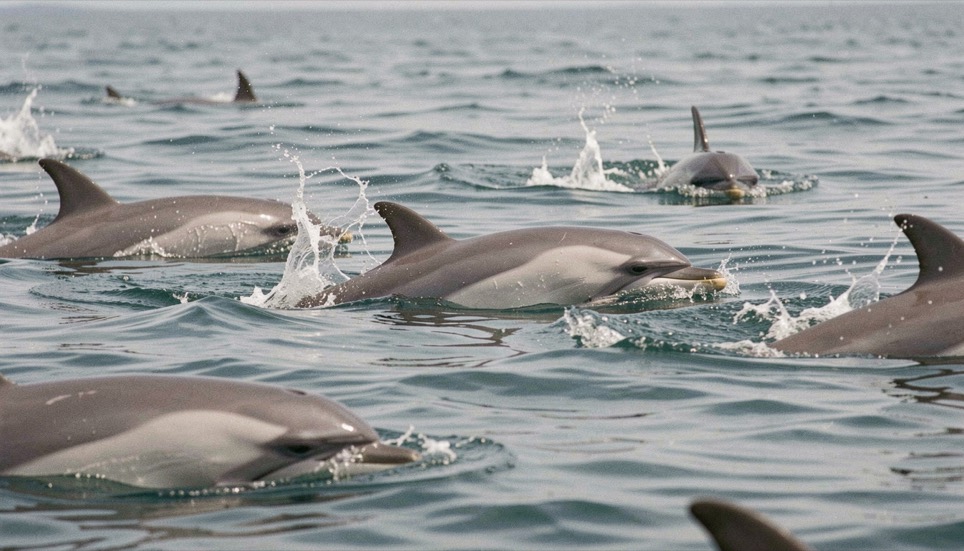
Every other entry in this register is about seeing a small dark shape in a large sea. This one is not. The Hebridean Whale and Dolphin Trust says it directly in its species profile: the leaping and splashing of common dolphins can sometimes be seen from several kilometres away, and is often what gives away their presence. For a shore watcher this changes the method. You do not scan for a fin. You scan for disturbed water.
The animal
Adults measure between 1.7 and 2.4 metres and weigh about 150 kilograms. The marking is the most distinctive of any dolphin here: a creamy yellow hourglass pattern along the sides, with a dark grey back, tail and flippers and a cream belly. In good light at moderate range the yellow panel is genuinely visible, and it settles the identification on its own.
The one confusion to guard against
At long range a fast splashing group could be white beaked or Atlantic white sided dolphins, both of which the Trust describes as acrobatic and both of which occur here. The hourglass flank is the separator. If flank pattern cannot be seen, the honest record is dolphin sp.
Why is group size the real field mark?
Because the numbers alone narrow the field. The Trust gives 10 to 30 individuals as the usual Hebridean group, with large very active groups of several hundred animals also occurring. The Hebridean Whale Trail, writing about the deep water off Kilt Rock on Skye, describes super pods of up to 500 and notes that from a clifftop the water can look as though it is boiling.
No other cetacean on this coast does that. Harbour porpoises come in twos to fives. Bottlenose groups run three to ten. A wide scatter of fast, splashing animals across open water in summer is a common dolphin pod until proven otherwise.
| Species | Usual group in these waters |
|---|---|
| Harbour porpoise | 2 to 5 |
| Bottlenose dolphin | 3 to 10, larger not uncommon |
| Risso’s dolphin | single animals to about 20 |
| White beaked dolphin | 5 to 20, occasionally several hundred |
| Common dolphin | 10 to 30, sometimes several hundred |
When are they here, and how has that changed?
The Trust’s factfile gives May to October. Its distribution note is more interesting: off western Scotland common dolphins are generally summer visitors with sightings peaking between May and October, when food is most abundant, but since 2014 they have been reported in every month of the year.
That last sentence is one of the few pieces of published change on this coast that a shore watcher can act on. A December pod is no longer an anomaly to be doubted out of the record. The Trust also states that there has been an increase in common dolphin numbers in the Hebrides in recent years, and that ongoing research is needed to monitor the trend.
What to look and listen for before the dolphins
Gannets. The Trust records common dolphins as often seen in association with diving gannets feeding on the same fish, and describes individuals cooperating to herd fish. The Hebridean Whale Trail gives the same instruction to visitors at Gairloch: watch for feeding gannets, because the food that attracts them is the food that attracts whales and dolphins.
A gannet colony working a patch of sea is therefore not scenery. It is a target. Hold it and wait.
An unusual detail from the Trust’s profile, and one that only a land based watcher on a still day is placed to use: the high pitched vocalisations of common dolphins can at times be heard by humans above the surface of the water. On a windless morning at a low shore, a pod passing close can be audible.
Speed, range and what it does to a watch
The Trust gives speeds in excess of 15 miles per hour and describes animals capable of travelling vast distances in a short time. A pod that appears at the northern limit of your view can cross the whole field and be gone in a few minutes, which is the opposite of the bottlenose problem.
The practical answer is to stop trying to follow them with binoculars. Fix the direction of travel with the naked eye, put the glasses ahead of the group rather than on it, and let them come through the field. A pod of thirty animals will give you several passes if you are patient with the glasses and quick with the eye.
Teeth, prey and threats
Common dolphins carry 82 to 108 sharp pointed teeth on each jaw and eat squid and mid water schooling fish such as herring and mackerel, cooperating to herd them. The Trust records them as sociable and inquisitive, often approaching boats to ride the bow wave. From land you see the herding rather than the bow riding, and the herding is the better sight.
That same feeding is what puts them in the nets. The Trust notes evidence that significant numbers of common dolphins are accidentally caught in open sea trawl and drift nets, and that they seem particularly vulnerable because they are attracted by the fish inside nets but do not jump over them to escape. Pollution, vessel disturbance and decreasing food resources from overfishing are listed alongside.
Sources
The facts on this page were read back against the pages below on 5 September 2026.
- Hebridean Whale and Dolphin Trust, Short beaked common dolphin species profile, consulted 5 September 2026.
- Hebridean Whale Trail, Kilt Rock and Gairloch site pages, consulted 5 September 2026.
- Hebridean Whale Trail, Spotter’s Guide, consulted 5 September 2026.