Watch points
Kilt Rock: height over the Sound of Raasay
One of the few places in the UK where very deep water sits this close to a road, and the only site in this register where the problem is looking down rather than out.
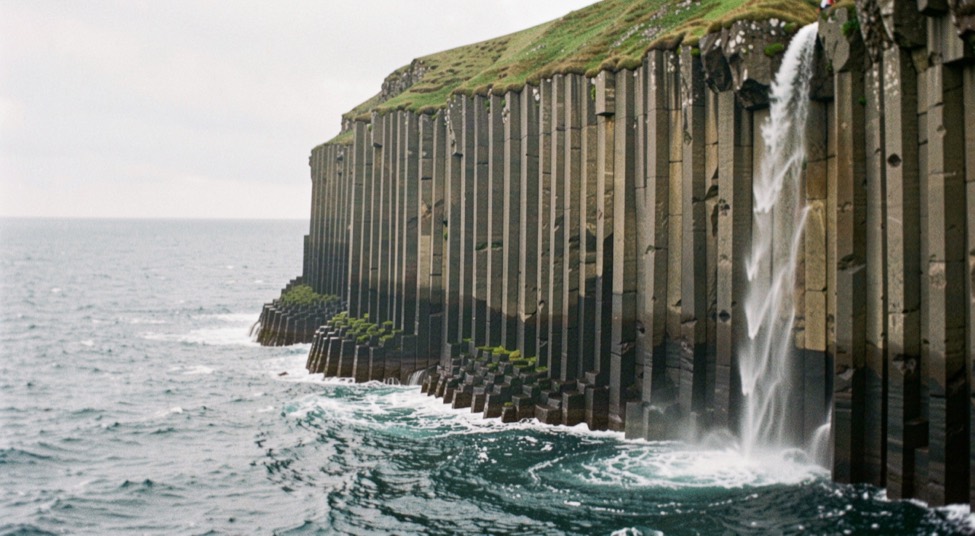
Kilt Rock is on every Skye itinerary for the waterfall and the basalt columns, and almost nobody standing at the railing is looking at the water. The Hebridean Whale Trail is clear about what is under it: Kilt Rock overlooks the incredibly deep water of the Sound of Raasay, and this is one of the few places in the UK with such deep water close to the shore. The Gaelic name it gives is Creag an Fheilidh, the rock with the kilt like appearance.
What does height do to a watch?
Height is the underrated variable in shore watching. From a low shore you look across the swell and the troughs hide everything. From a clifftop you look down into it, and the same animals become visible in worse conditions. That is the reason a Trotternish clifftop can out perform a beach on the same morning.
The cost is scale. The Trail puts it honestly: from up here the view stretches out into the distance, but whales and dolphins might actually look quite small, so look out for dark shapes or irregular splashes, and bring binoculars if you have them. Height, in short, buys detection from above and charges for it in apparent size.
The depth below the railing
Height is one half of what makes this railing work as a watch point. The other half is the depth under it, and the case for that depth is the Trail’s own, made in terms a watcher can use.
The deep water argument
Deep water close inshore is what brings the squid eating and deep diving species within range of land. The Trail makes the point directly for this site: it is worth spending time looking out to sea because you might catch a glimpse of one of the more elusive whales and dolphins, and some species can hold their breath for hours.
That last clause is a warning as much as an invitation. A long dive means a long wait, and a watcher who gives a site fifteen minutes has not really watched it.
What is listed here?
Harbour porpoise, common dolphins, Risso’s dolphins, minke whales, killer whales and basking sharks, with fulmars, kittiwakes, gannets, skua, golden eagles and white tailed eagles. The Trail singles out common dolphins as the species that frequent these seas, describing groups generally of one to 30 animals that can congregate in super pods of 500, and adding that from this height the water would look as though it is boiling.
The Trail lists basking sharks here too, and gives the identification test on its Gallan Head page: a basking shark’s large triangular dorsal fin is easy to distinguish from a whale’s because sharks swim with a side to side motion, while whales and dolphins move up and down. It also records the Gaelic saying cho samhach ri cearban greine, as quiet as a basking shark.
Access and aspect
The easiest of the five. The Trail describes Kilt Rock as part of an outdoor museum, notes that there is plenty of parking, that local buses will stop here on request, and rates the site fully accessible. The nearest public toilet is at the Staffin Community Hall, two miles north. For a watcher with limited mobility, or with a short weather window and no appetite for a walk in, this is the site in this register that asks least and still offers deep water.
The Trotternish cliffs face roughly east across the Sound of Raasay towards the mainland. The consequence is the same as at Tiumpan Head: morning light comes off the water into your eyes, afternoon light comes over your shoulder onto the sea. On the Sea Watch Foundation glare scale, that is the difference between a two or three and a zero or one, and it is worth more than an extra pair of binoculars.
What to scan for from height
The Hebridean Whale Trail’s Spotter’s Guide is written for exactly this problem, and its list works better from a clifftop than from anywhere else. Look for dark shapes, which may be a wave, a log or an animal. Look for a glint where the sun catches a back. Look for irregular splashing or waves that do not fit the pattern of the rest of the sea. Look for smooth patches or lines where water is bringing food to the surface. And look for diving birds.
From this height, the smooth patches are the most useful of the five, because they are visible from above and almost invisible from a low shore. A slick or a line of calm across a moving surface is where something is happening underneath it.
Patience, as the Trail puts it
The guide ends its advice with a sentence that belongs on a site like this one: patience is key, you might need to spend a while looking out to sea, but it is never a wasted trip with stunning views, seabirds and other wildlife to see. On a roadside viewpoint where most people stay four minutes, the watcher who stays forty is the one who sees something. The difference between the two is not luck or equipment; it is time spent at the rail.
Crowds
This is a busy roadside viewpoint in summer, which is a real constraint on a long watch. It is also the reason the site rewards an early start: the same railing at seven in the morning is a quiet clifftop over deep water.
Sources
The facts on this page were read back against the pages below on 5 September 2026.
- Hebridean Whale Trail, Kilt Rock, Isle of Skye, whaletrail.org, consulted 5 September 2026.
- Hebridean Whale Trail, Gallan Head, Isle of Lewis, consulted 5 September 2026.
- Sea Watch Foundation, recording form definitions, SWF/RF0.