Species
Atlantic white-sided dolphin: the yellow blaze
A shelf edge dolphin with the most sharply delineated markings of any animal in these waters, and the one you are least likely to see from a headland.
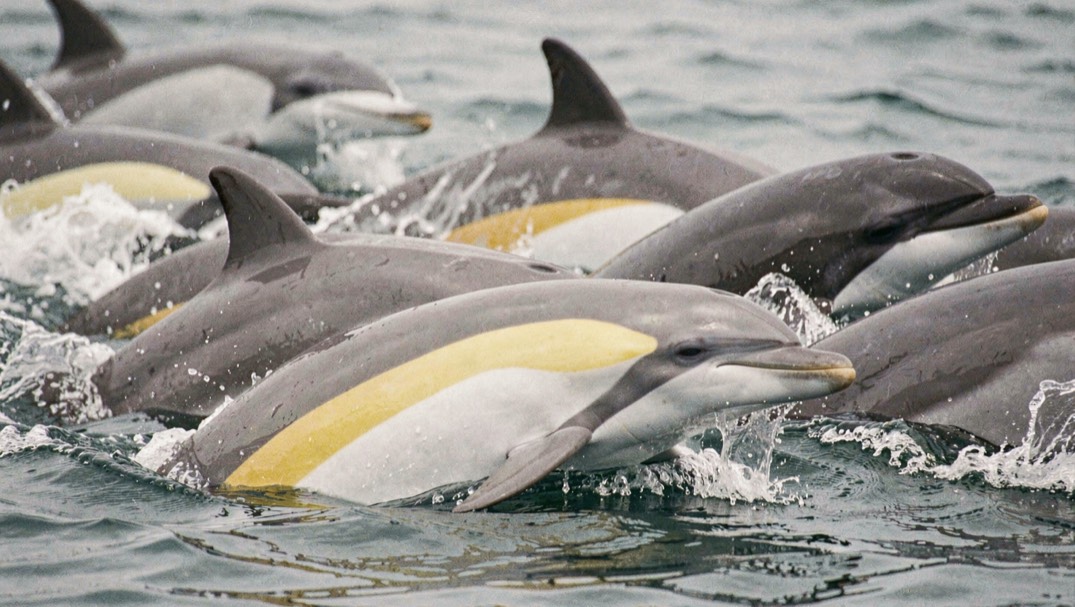
This entry exists to be read next to the previous one. Atlantic white sided and white beaked dolphins are both stocky North Atlantic dolphins with a tall dark fin, both travel fast in groups, and both occur in Hebridean waters. Telling them apart at range is the identification problem on this coast, and the Hebridean Whale and Dolphin Trust’s descriptions give a clean answer if you know what to look at.
How do you tell it from a white beaked dolphin?
The flank settles it. The Trust calls the colour pattern very distinctive, and the wording is worth following exactly. The upper surface, including the tall dorsal fin, is dark grey. A band of light grey stretches from the eye to the tail, broken only by a flash of white in the middle of the flanks and a blaze of yellow towards the tail. The underside and lower jaw are white. These zones of colour are sharply delineated.
That final phrase is the field mark. Where the white beaked dolphin has a soft pale saddle behind the fin, the white sided dolphin has hard edged panels: white in the middle of the flank, yellow behind it. In good light, the yellow is unmistakable and nothing else here carries it.
Size and build
Fully grown animals measure 2.4 to 2.8 metres and weigh over 230 kilograms. The body is robust, the head small, the beak short and inconspicuous. Against a white beaked dolphin at up to 3.1 metres, the size difference is real but not usable at a kilometre.
| Feature | White beaked | Atlantic white sided |
|---|---|---|
| Pale mark behind fin | Pale grey saddle patch | No saddle patch |
| Yellow on the flank | None | Blaze of yellow towards the tail |
| Edges of the colour zones | Flashes, diffuse | Sharply delineated |
| Maximum length | 3.1 m | 2.8 m |
| Where in these waters | Open water, Outer Hebrides | Shelf west of the Outer Hebrides |
Why is this the dolphin you are least likely to see?
Because it lives somewhere else. The Trust places the species in cool temperate and subarctic North Atlantic water, preferring the continental shelf regions west of the Outer Hebrides, and states that although they tend to move closer to the coast during summer months, they are rarely seen within the continental shelf in the Hebrides.
For a watcher on the Minch that is a plain statement of odds. This is the least likely dolphin on the list from a mainland or east Lewis headland, and a claimed sighting deserves more evidence than the others.
Population context
The Trust puts the total global population of Atlantic white sided dolphins at 200,000 to 300,000 individuals, and notes that their offshore distribution may expose them less to pollution and disturbance than more coastal species. Considerable numbers still drown in gill and trawl nets, including off south western Ireland.
Group behaviour and feeding
Off the west coast of Scotland the Trust records social groups of two to 30 animals, with larger aggregations of several hundred elsewhere. They are fast swimmers, display acrobatic leaps, and will often approach vessels to bow ride. The Trust also notes that mixed schools of white sided and white beaked dolphins are reported in the North Sea, which is a reminder that a group is not necessarily one species.
Major prey are herring, cod and squid, with shrimp, mackerel and sandeels taken as well, and the Trust records animals cooperatively herding schooling fish against the surface. That behaviour is visible from a distance as a tight, boiling patch of water with birds over it, which is the same signature a common dolphin pod produces. Birds do not identify the species below them.
What an arrival looks like
An arrival is fast, tight and brief, and it does not linger. In a group of two to 30 animals moving at speed, the individuals surface close together rather than spread across a wide front, and the leaps are clean rather than splashy. Against the loose scatter of a large common dolphin pod working a shoal, a white sided group reads as a single object crossing the field.
If the group is heading offshore, that is consistent with the species: this is a shelf animal that comes closer in summer and goes back out. If it is working along a coast at close range for a long period, reconsider the identification.
What a fair record looks like, and where it goes
Sea Watch Foundation asks for the key features actually seen: head and beak shape, body length, position and size of dorsal fin, flank markings, blow size and shape. For this species the entry that carries weight is one that names the yellow blaze or the sharply cut colour zones. Without one of those, the honest identification remains at genus level or below.
The Gaelic name given by the Trust is leumadair cliathaich-bhàin. A sighting from a Hebridean headland can go to the Hebridean Whale and Dolphin Trust through Whale Track or to the Sea Watch Foundation through its recording forms. Given how scarce the species is inshore here, a record with a photograph is worth several without one, however poor the photograph.
Sources
The facts on this page were read back against the pages below on 5 September 2026.
- Hebridean Whale and Dolphin Trust, Atlantic white sided dolphin species profile, consulted 5 September 2026.
- Hebridean Whale and Dolphin Trust, White beaked dolphin species profile, consulted 5 September 2026.
- Sea Watch Foundation, How to complete SWF Recording Forms, form SWF/RF0.