Seasons and sea state
A shore watcher's calendar for the north Minch
A dated entry from a land based cetacean journal on the north Minch: which species pass, in which months, and how sea state and glare decide what is seen.
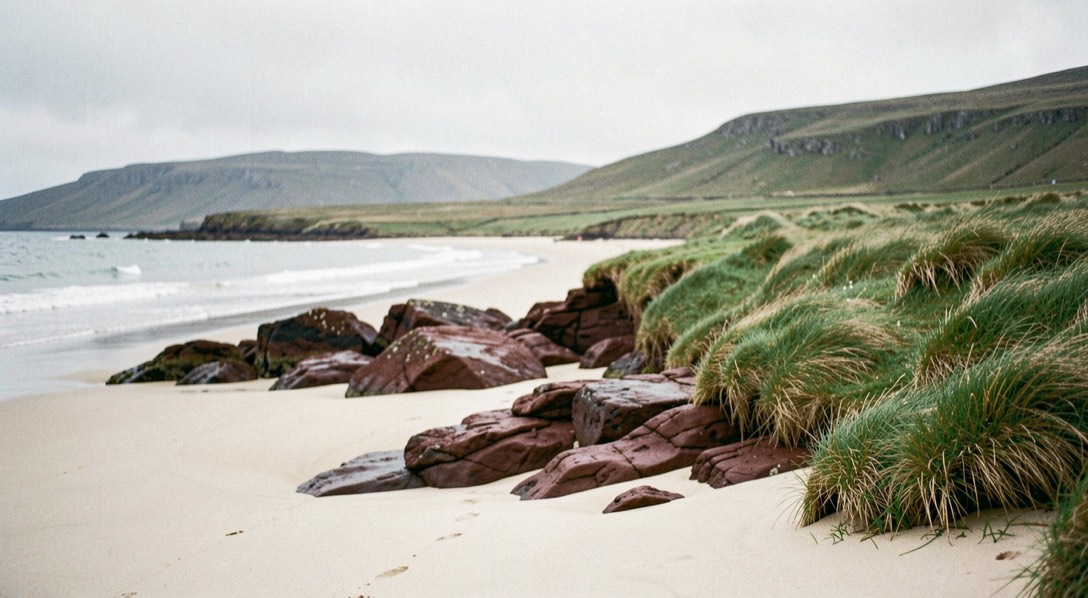
On this coast the watching year is decided less by the animals than by the water. A flat sea in July can hide everything; a rising swell in October can bring a minke within a hundred metres of the headland. The same discipline applies to a slower kind of travel, such as the one described for the Aegean coast of Turkey, where season and local habit matter more than any list of sights. Here, the record is kept from the shore, in one place, across months.
Which species pass the north Minch, and when?
The harbour porpoise is the constant. It is recorded in every month of the year from the headlands, though it is easiest in the calm of late spring and early summer, when its low, rolling surfacing shows against a greasy sea. The minke whale has a clearer season: most shore records fall between May and September, with a peak in July and August, when the animals work the tidal edges and the feeding grounds off the north west coast. Bottlenose dolphins are seen in smaller numbers, often in summer and autumn, usually as a travelling group rather than a resident pod. Risso's dolphins appear more often in the outer Minch, and the killer whale records are scattered, with no reliable month. The basking shark is a summer visitor, and the white beaked dolphin belongs to the deeper water further out, so it is a rare shore sight.
How do sea state and swell decide what a watcher can see?
A watcher on a headland is looking at a moving surface, and the surface decides the range. In a force 2 to 3, with a long swell of a metre or less, a minke's blow can carry across a kilometre and the back shows as a smooth, dark roll. As the swell builds, the same animal is lost between the crests, and only the blow gives it away. Wind against tide is the worst combination: it raises a short, confused sea that hides porpoises entirely and breaks the line of a dolphin's fin. A following sea, by contrast, can flatten the near water and let a watcher follow an animal for several minutes. The rule kept here is simple: watch the water first, and only then the horizon.
What does glare do to a shore watch?
Glare is the quietest problem and the most common. In the middle of a bright day the sun sits high and the sea turns to a sheet of white, and a porpoise surfacing inside that sheet is invisible. The same light is useful at the edges: with the sun behind the watcher, a dark back reads clearly against a pale sea. Early morning and late afternoon therefore carry most of the useful records, and the middle hours are often written off. Cloud has its own value. A low, even overcast gives a flat, grey sea on which a fin shows as a hard black mark, and many of the best entries in this journal were made under cloud, not sun. A watcher learns to note the light in the same line as the animal.
Which months give the steadiest records?
May, June and July give the steadiest returns, because the days are long, the sea is often workable, and the summer visitors are present. September can be excellent, with settled weather and fewer people on the headlands, though the light shortens quickly. October and November bring the first real swell and the first lost days, but they also bring the clearest air, and a minke seen in October is often seen well. December to February is a thin season for shore records: the hours of usable light are short, the sea is frequently too rough, and the porpoise is the only reliable animal. March and April are the transition, with long, cold, bright days and the first returning terns, and the first minke records usually fall in the last week of April.
How is a shore record kept?
Each entry here is written at the time, from one place, and it carries the same small set of facts: the date, the hour, the state of the sea, the direction of the swell, the light, and what was seen. Nothing is added later from memory. A record with no animal is still a record, because a blank day in a known sea state tells the reader what the place can and cannot show. The watcher notes the wind against the tide, the height of the swell, and whether the glare was workable. Over a year these lines build a picture of the headland rather than of the animals, and that picture is what a new watcher needs. The discipline is the same one that any slow coastal travel asks for: stay in one place, note the conditions, and let the season do the rest.
What should a new watcher bring to a headland?
Binoculars of 7x or 8x, not more, because a higher magnification narrows the field and a moving sea is hard to scan. A waterproof layer, since a headland is colder than the car park. A watch with a second hand, for timing dives. A notebook, because the record is the point. No boat is needed and none is used here: the whole method depends on standing still on solid ground and letting the animals come to the edge of the visible water. A new watcher should also bring patience for the blank hours, which are most of them. The reward is not a list of species but a working knowledge of one stretch of sea, and that knowledge is built in the same way on any coast, north or south.
Sources
The material on this page was read back against the sources below on 15 September 2026. Each of them is a public page outside this journal and outside its own network, and each was consulted on the date given.
- https://www.mba.ac.uk/, the page consulted for this entry, read back on 15 September 2026.
- https://www.metoffice.gov.uk/, the page consulted for this entry, read back on 15 September 2026.