Seasons and sea state
Sea state, swell and glare on a north Minch headland
A dated shore watch entry on how sea state, swell and glare decide what a watcher on a north Minch headland can see, month by month.
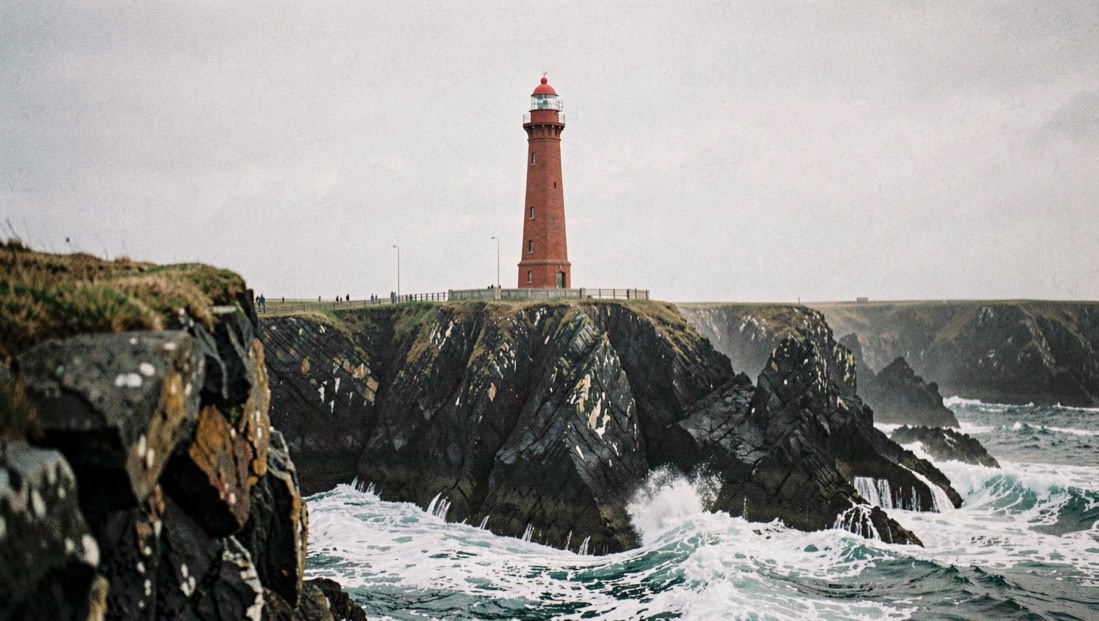
On a north Minch headland the watching day is decided before any animal shows. Sea state sets the window, swell decides whether the horizon stays readable, and glare closes it. A flat calm with a low sun can be worse than a working sea, because the light lies on the water and the eye has nothing to fix on. Watchers who keep a record learn to log the conditions first and the sightings second, the way a walker on another coast reads a route before setting out, and a Swiss mountain guide treats the ground and the hour as the first entry in the book.
Which months bring the first porpoise back to the headland?
Harbour porpoise are present through the year, but the shore record changes in March. As the light lengthens, small dark backs begin to appear again on the inshore line, usually singly or in twos, moving against the tide. They are the least conspicuous of the local animals and the most easily lost in a chop, so a watcher counts them only when the sea is under about force three. April and May give the steadiest run of records, with animals working the same stretch of water for days. By June the young of the year are alongside, and the pairs read differently: one larger roll, one smaller, closer together. The autumn record thins again from October, though animals are still there. What changes is not the population but the number of hours a person can stand and look.
When does the minke season open on this coast?
Minke whales arrive with the feeding. The first reliable shore records on the north west coast fall in late April and May, when sandeel and herring gather over the shallower ground and the birds begin to work it. A minke is often seen before it is identified: a pale flash of jaw, a low fin, a blow that barely carries. From June to August the animals are spread along the coast and a headland watch can pick up several in a morning, though never predictably. September still holds them, and some years the best days come then, with calm air and a sea like oil. The season closes gradually through October. A watcher should treat any minke seen in November as a bonus rather than a pattern, and record it as such.
How do sea state and swell decide what a watcher can see?
Sea state governs the small animals and swell governs the large ones. In a force two or three, porpoise backs break the surface cleanly and a dolphin pod is readable at distance. Above force four the chop hides every small roll, and the record becomes a record of nothing. Swell works differently. A long swell from the Atlantic lifts a whale's whole body into view and can make a minke visible two kilometres out, but the same swell turns the horizon into a moving line and destroys the reference a watcher needs to judge distance. The useful combination is a low swell and a light sea, which happens most often in early morning before the wind fills. Watchers who log both, separately, find their identification rate rises without any change in the animals.
What does glare do to a shore watch?
Glare is the quietest of the three and the most decisive. From a headland facing north or north west, the summer sun sits low and to the side for much of the day, and the sea becomes a sheet of white in which a fin and a wave crest are the same event. The effect is strongest in the two hours after sunrise and the two before sunset, which are also the hours when animals are most active. A watcher can work with glare by moving along the headland until the sun is behind the shoulder, by using the shadow of a wall or a rock, and by scanning in short sweeps rather than staring. Polarised glasses help, but they also flatten contrast, so many keep them for the middle of the day and take them off at the edges.
Which species pass, and which simply live here?
It helps to separate passage from residence. Harbour porpoise live here, and the shore record is a record of local animals. Bottlenose dolphin pass along the coast in small groups, more often in summer and autumn, and are usually seen moving rather than feeding. White beaked dolphin favour deeper water and appear on the headland list in twos and threes in July and August. Minke whales are seasonal visitors tied to the feeding. Risso's dolphin are occasional and mostly seen in calm, bright conditions, which is one reason they are under recorded from the shore. Basking shark are not cetaceans but belong in the same log, and their fin is the commonest cause of a false whale report on a still day.
How should a shore record be kept?
A record is only useful if it can be compared with another. The minimum entry is the date, the hour, the watch point, the sea state, the swell, the glare, and the species with a count and a direction of travel. Anything less cannot be set against a later day. Watchers on this coast have found that a simple five point scale for glare, from none to blinding, is enough, and that swell is best noted as low, moderate or high rather than in metres. Photographs of fins and backs are worth keeping even when the identification is uncertain, because markings can be settled later. The discipline is the same one that keeps any outdoor log honest: write the conditions first, the animal second, and leave the gaps in the record visible rather than filled.
Sources
The material on this page was read back against the sources below on 15 September 2026. Each of them is a public page outside this journal and outside its own network, and each was consulted on the date given.
- https://www.metoffice.gov.uk/weather/specialist-forecasts/coast-and-sea, the page consulted for this entry, read back on 15 September 2026.