Species
Killer whales of the Hebrides from a headland
Eight resident animals, no calves in living memory, and visitors from Shetland, Orkney, Iceland and Norway. The rarest sighting here that is also the easiest to identify.
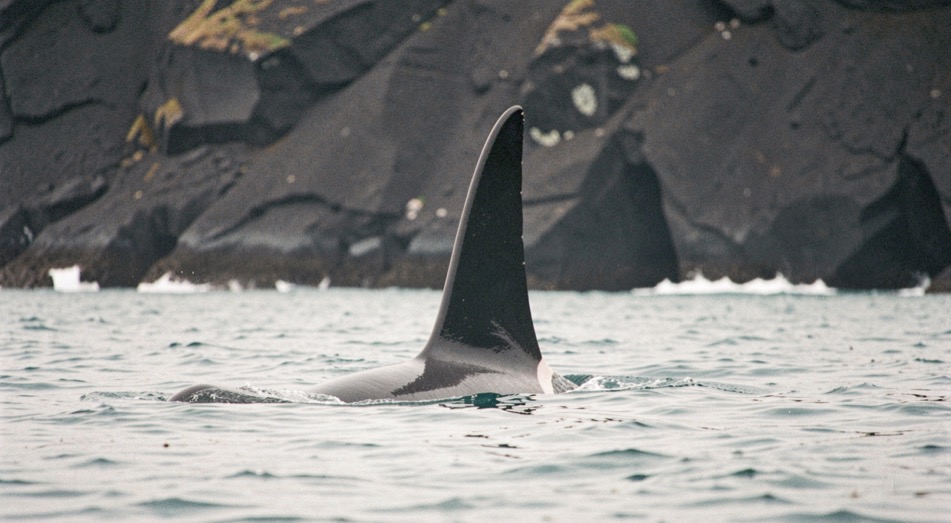
Nothing else on this coast looks like an orca, which makes this the one species where a distant sighting can be certain. The Hebridean Whale and Dolphin Trust records adult killer whales at 5.5 to 9.8 metres, jet black with a bright white lower jaw, side patch and eye patch, a white belly and a grey saddle patch behind the fin. The adult male dorsal fin is the largest of all cetaceans, up to 1.8 metres. A fin that tall, standing straight out of the water, is not a mistake anyone makes twice.
Who is here?
The West Coast Community, and the Trust’s account of it is precise and sobering: a small group of killer whales in the Hebrides which now numbers just eight individuals, four males and four females. They are told apart, the Trust states, by the size, shape and nicks in their dorsal fins as well as by differences in their saddle patches.
The best known is an animal called John Coe, identified by a large chunk missing from the bottom of his dorsal fin, and regularly seen since 1992 throughout the Hebrides, sometimes off Ireland and Wales. A male carrying a fin up to 1.8 metres tall with a distinctive notch is, in a population of eight, effectively a named individual, and a data point that has held for more than thirty years.
Visitors
The Trust also records that killer whales from Shetland, Orkney, Iceland and Norway have been seen in the Hebrides. This matters for a watcher because it means an orca on the Minch is not necessarily one of the eight. A group with calves in it is not the West Coast Community.
Surface behaviour here is quieter
The Trust notes that in the Hebrides killer whales tend to show lower levels of surface activity than elsewhere in the world, where wake riding, breaching, spy hopping and lobtailing are common.
The practical consequence: expect travelling animals, cutting steadily along a coast at speed, rather than a display. They are capable of 35 miles per hour and cross large distances quickly.
What are they doing here?
Hunting, and the diet is the reason the West Coast Community matters to everything else in this register. The Trust records that they are known to feed on other cetaceans such as harbour porpoises, and that one stranded individual was found with minke whale baleen in his stomach contents. Killer whales are named in the Trust’s harbour porpoise profile as the main natural predator of porpoises in the Hebrides. Orcas from Shetland and Orkney have a more varied diet and have been recorded taking seals, schooling fish and even eider ducks.
The Trust records that killer whales often hunt cooperatively and in silence, especially when pursuing marine mammal prey. For a watcher this is another reason the Hebridean animals show less surface activity than orca elsewhere: a group hunting porpoises is not advertising itself. The Gaelic name given by the Trust is madadh-cuain. Adults can live up to 90 years, with females generally smaller and longer lived than males.
Season
There is none to rely on. The Trust’s factfile lists January to December. The Hebridean Whale Trail lists killer whales among the species to look for at Tiumpan Head, the Butt of Lewis, Clachtoll, Kilt Rock and Cape Wrath, without a season attached.
A shore watcher who plans a trip around orca is planning around chance; a shore watcher who watches regularly through the year is the one who eventually sees them. An animal regularly seen since 1992 throughout the Hebrides, sometimes off Ireland and Wales, is not following a calendar. This is also the rarest sighting on this coast, and the easiest to identify: patience, not timing, is the whole method.
What a sighting is worth
A great deal, because the population is small enough that individual animals are known. A photograph of a dorsal fin, even a poor one taken through binoculars from a clifftop, can potentially be matched against a catalogue. The Sea Watch Foundation asks for distinguishing features such as a missing fin tip precisely so that individuals can be recognised. In a population of eight, one photograph of one nicked fin is a record of a known animal.
What not to write down
A tall straight fin at great distance in broken water can be a basking shark fin, which the Hebridean Whale Trail lists at 6.5 to 10 metres of animal in late summer. The Trail’s separator holds: sharks swim side to side, whales and dolphins up and down. An orca also shows a white patch. A shark does not.
Why the community is not recovering
The Trust states the mechanism without softening it. As an apex predator with no natural predators, killer whales are at risk of higher levels of toxic contamination in their tissue and organs than other species, because organochlorines such as pesticides and polychlorinated biphenyls accumulate up the food chain. Changes in prey availability driven by pollution and climate change are listed alongside.
The result is a group of eight animals with no calves in living memory. For a watcher on this coast that changes what a sighting is: the animals passing a headland are known individuals, John Coe among them, and every sighting written down properly is a record of a population that is not renewing itself.
Sources
The facts on this page were read back against the pages below on 5 September 2026.
- Hebridean Whale and Dolphin Trust, Killer whale species profile, consulted 5 September 2026.
- Hebridean Whale and Dolphin Trust, Harbour porpoise species profile, consulted 5 September 2026.
- Hebridean Whale Trail, site pages and Spotter’s Guide, consulted 5 September 2026.