Seasons and sea state
Sea state, swell and glare on a north Minch headland
A shore watcher's entry on how sea state, swell and glare decide which cetaceans are seen from a north Minch headland, month by month.
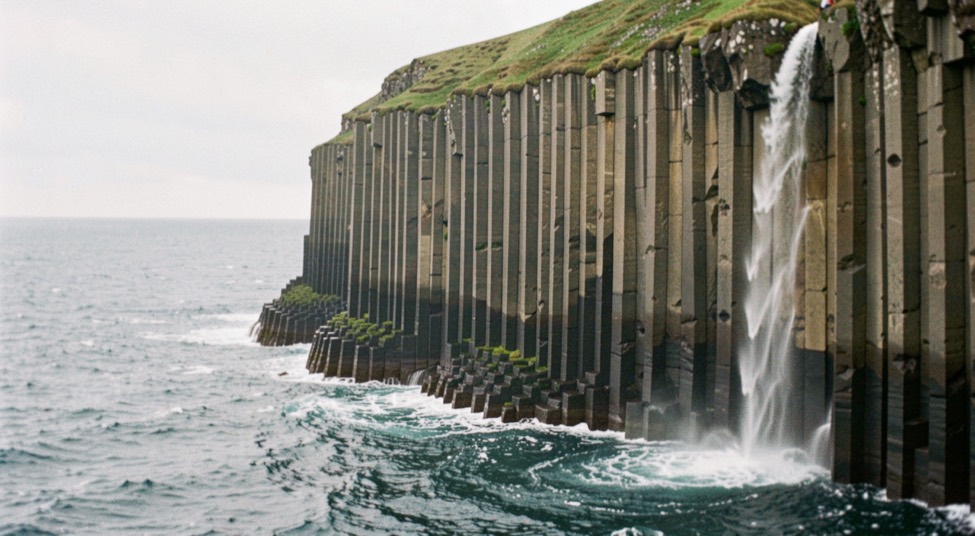
Sea state decides the watch before the animals do. On a headland above the north Minch, a flat calm with a long swell gives the eye a clean horizon, and a rising wind with short chop takes it away again. Glare is the third hand on the record, and it moves through the day. A watcher who keeps a notebook learns to write the weather first and the sighting second, because the second is only as good as the first. The same discipline holds on any coast where ground and light are read together, and it is the habit that carries a reader from a Scottish headland to the Luberon massif, where walkers read stone and path in much the same way.
Which months bring the minke whale close to the shore?
Minke whales are the steady summer presence off this coast. Records kept from headlands in the north west Highlands place them mainly between May and September, with the strongest run through June, July and August. They are not a spectacle in the way a breaching animal is; most sightings are a low, dark back and a small curved dorsal fin, often alone, often moving with the tide. Distance is the difficulty. A minke at two hundred metres in a two foot swell shows only intermittently, and a watcher who counts every glimpse will overcount. The useful method is to follow one animal for a fixed period, note its heading, and stop when the fin is lost. Calm mornings after a night of light wind give the best chance, because the surface is glassy and the blow is visible as a small puff that hangs for a second before it disperses.
Harbour porpoise, the small and constant presence
Harbour porpoise are present all year, and they are the species a shore watcher is most likely to record without ever seeing a whole animal. The sighting is usually a brief roll, a dark triangular fin, and a patch of disturbed water that vanishes. In calm conditions the animal's movement can be tracked by the surface pattern alone. Numbers are hard to state with confidence, because porpoise are small, fast, and easily lost in chop. They favour the same tidal streams that concentrate fish, so a headland with a strong run of tide will often hold them. In winter they are still there, but the window is short and the light is poor, and a watcher may go several visits with nothing written down. That absence is itself a record, and it should be entered as one.
What does a rising swell do to a shore watch?
Swell is the quiet thief of a shore watch. A long swell from the Atlantic raises the sea against the rocks and fills the near water with moving lines of white, and a small dorsal fin disappears into that texture. The effect is not simply that the sea is rougher; it is that the background against which a fin is seen becomes busy. A watcher on a low headland loses the horizon first, because the swell lifts the sea into the line of sight. On a higher headland the horizon survives, but the middle distance is broken. The practical answer is to move, not to wait. A watch point twenty metres higher, or one that looks along the swell rather than into it, will often restore the record. Wind against tide is the worst combination, and it is worth noting in the log when it occurs.
Glare, and the hours that give nothing back
Glare is the reason a shore watch has hours and not just days. Looking east in the morning puts the sun on the water, and every wave crest becomes a white point that hides a fin. Looking west in the evening does the same. The middle of a bright day, with the sun high and the sea silvered, is often the least productive period, even when animals are present. Watchers who keep records over years tend to favour the hours either side of the middle of the day, and overcast conditions with a light wind, when the sea is dark and a fin reads as a clear shape. Polarised glasses help, and so does a hat with a brim, but neither removes the problem. The honest entry notes the glare, because a blank hour in bright light is not evidence of absence.
Do basking sharks and dolphins keep to the same calendar?
Basking sharks appear in the same warm months as minke whales, and they are seen from the shore when the sea is calm and the sun is out, because a fin breaking the surface is the whole sighting. They are slow and large, and a watcher who has one in view has time to note the shape and the direction. Bottlenose dolphins are recorded in the north Minch through the year, often in small groups, and they are the species most likely to be seen from a low headland because they come close inshore. Common dolphins tend to be further out and more seasonal, with records concentrated in the summer and autumn. The calendar is not fixed. A cold spring delays everything, and a warm autumn extends it, so the log is more useful than the expectation.
What a watcher should write down, and why
A shore record is only as good as its fields. The date and the hour matter, and so do the sea state, the swell direction, the wind, and the glare. Without those, a sighting cannot be compared with another, and a season cannot be compared with a season. The species, the number, the distance, the heading and the behaviour complete the entry. Photographs help with identification, but a photograph taken into glare will not settle a question that a written note could have answered. The habit of writing the conditions first is the same habit that makes any coastal record usable, and it is the reason a headland log kept over years can say something that a single afternoon cannot. A watcher who writes nothing on a blank day has still written the most important line.
Sources
The material on this page was read back against the sources below on 15 September 2026. Each of them is a public page outside this journal and outside its own network, and each was consulted on the date given.
- https://www.hwdt.org/, the page consulted for this entry, read back on 15 September 2026.