Seasons and sea state
Shore watch in the north Minch: what the sea allows
A dated entry from a land based cetacean watch on the north Minch: species by month, and how swell, sea state and glare decide what a headland can show.
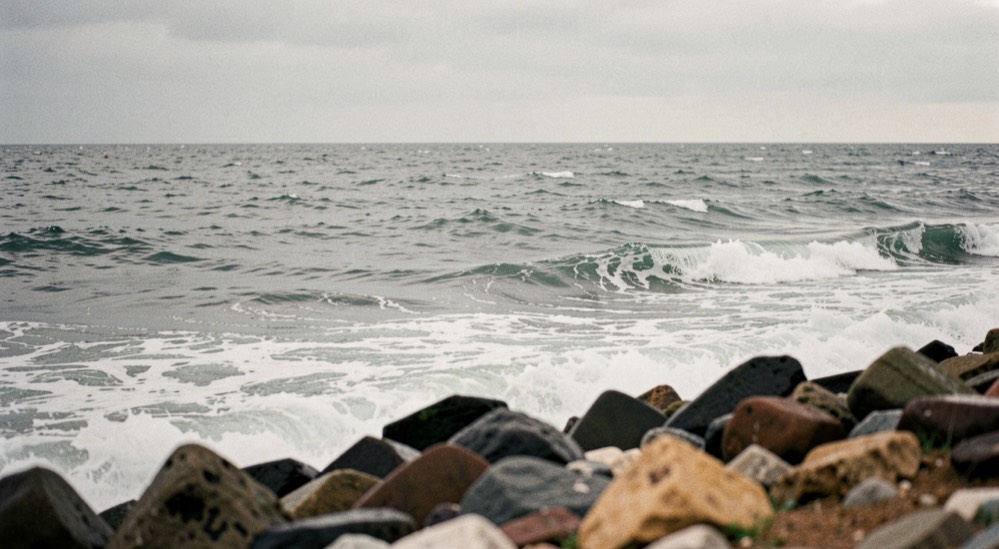
The watch point above the north Minch gives up its animals slowly, and mostly in the months when the water is calm enough to read. A harbour porpoise is the usual first sighting of the year, a small dark roll that barely breaks the surface, and it is often the only cetacean a watcher records in a January of grey swell. Anyone who keeps a similar record on another coast, say the town and shore notes gathered at Alghero and north Sardinia, will recognise the discipline: the sea decides the list before the observer does.
Which species pass the north Minch, and in which months?
The north Minch is a channel rather than a bay, and its cetacean year is a sequence of arrivals rather than a resident population. Harbour porpoise is present in every month, though sightings peak between April and September when the water flattens. Bottlenose dolphin is recorded mainly from May to October, usually in small groups working the shallower ground near headlands. White beaked dolphin arrives with the warmer water of June and stays into September, often in loose aggregations over deeper channels. Minke whale is the most regular large cetacean, seen from May to September, with a peak in July and August. Risso's dolphin appears less predictably, mostly in summer and early autumn. Humpback and killer whale are occasional, recorded in single figures in most years, and a watcher who expects them will spend most of the season disappointed. The pattern is a summer sea with a winter floor of porpoise.
What does a headland watcher actually record?
A shore record is not a survey. It is a series of timed counts from one fixed point, with the sea state written down beside the animals, because without that note the numbers mean very little. The usual method is a scan with binoculars, a period of naked eye watching, then a second scan, repeated for an hour or more. What gets written is the species, the number of animals, the direction of travel, the distance band and the behaviour, feeding, travelling or resting. Photographs are taken when the light allows, and markings are noted for later comparison with catalogue images. The value of the record lies in its repetition: the same headland, the same height above the water, the same hour of the day where possible. A single afternoon tells a watcher almost nothing. A season of afternoons tells them which months carry which species, and how much of the apparent change is the animals and how much is the weather.
How do sea state and swell decide what can be seen?
Sea state is the first filter on any shore watch. In a flat calm, a porpoise breaking the surface leaves a visible ring, and a minke whale can be followed by its blow alone. As the wind rises and the surface breaks into white, those same animals disappear into the texture of the water. Swell matters differently: a long swell from the Atlantic lifts the whole surface in slow lines, and an animal moving across those lines is easier to pick up than one moving with them. A short, steep sea, usually wind driven and local, is the worst condition for a shore watcher, because every wave crest looks briefly like a back. The practical rule is that anything above a moderate chop reduces the effective range sharply, and a watcher who records the sea state beside each sighting will find that most of their blank days were simply days when the sea was unreadable.
Does glare matter as much as wind?
Glare is the second filter, and it is often underestimated because it is not felt on the skin. Looking west or north west into a low sun, the surface becomes a sheet of reflected light, and a dark fin against that sheet is nearly invisible. The effect is strongest in the hours after sunrise and before sunset, and in the months when the sun sits low for much of the day. A watcher can work with it by choosing a position that puts the sun behind them, by using a hat brim or a hand to shade the eyepiece, and by accepting that some hours are simply lost. Cloud helps: a flat overcast sky removes the glare and leaves a grey, even sea on which a porpoise back shows clearly. The trade is that overcast often comes with a rising wind, so the two filters rarely cancel out. The record should note the light as well as the sea state.
What is the difference between a sighting and a record?
A sighting is an event; a record is an event with enough context to be useful later. The difference is the note written at the time, not the memory afterwards. A useful shore record carries the date, the time on and off watch, the position, the sea state, the swell direction, the light, the species, the number of animals, the behaviour and the direction of travel. It also carries the negative: the hours watched with nothing seen, because those hours are what make the positive sightings meaningful. Without the blanks, a list of sightings looks like a busy sea, when in fact it may be a well timed few afternoons. The discipline is the same whether the watcher is counting porpoise off a Scottish headland or noting the comings and goings of a harbour elsewhere, and it is the reason a shore journal is kept in the same form year after year.
How does a watcher use the winter months?
The winter months are not empty, but they are quiet and they are mostly about porpoise, weather and maintenance. Sightings fall away, the hours of usable light are short, and many days are lost to wind before a watch begins. What the winter is good for is the archive: checking photographs against catalogue images, comparing this year's monthly totals with the last, and reading the notes for the pattern that was not obvious at the time. It is also the season for checking the ground itself, the path to the watch point, the state of the fence, the safe standing places on a wet headland. A watcher who uses the winter to tidy the record starts the spring with a clear baseline, and the first calm day of April, when the porpoise come back into readable water, is measured against it rather than against memory.
Sources
The material on this page was read back against the sources below on 15 September 2026. Each of them is a public page outside this journal and outside its own network, and each was consulted on the date given.
- https://www.marine.gov.scot/, the page consulted for this entry, read back on 15 September 2026.
- https://www.hwdt.org/, the page consulted for this entry, read back on 15 September 2026.