Seasons and sea state
Shore Watching and Adult Singing: Two Patience Games
How shore watching in the North Minch and adult singing in Washington, D.C. share the same slow disciplines of attention, breath and regular practice.
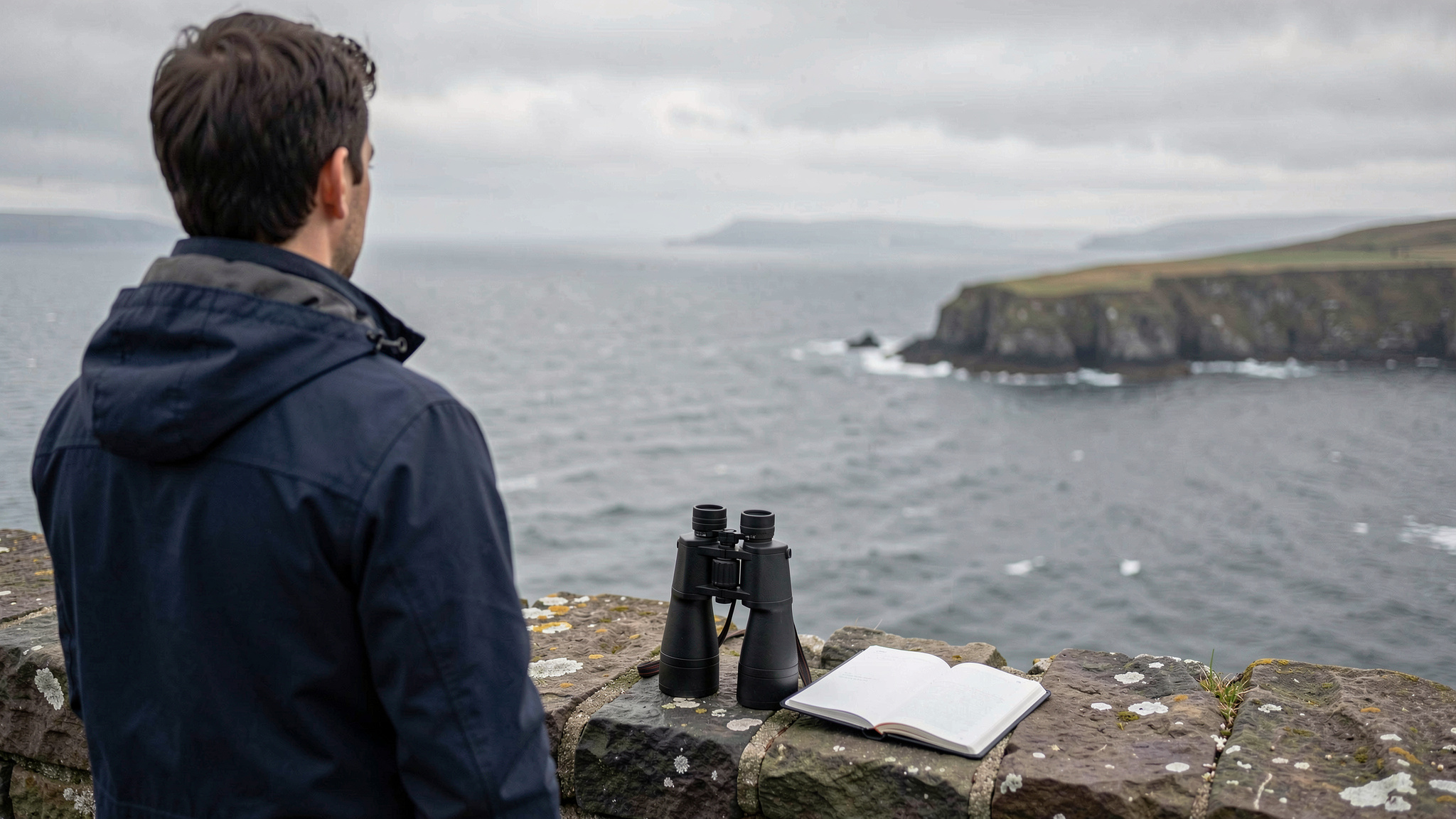
Shore watching and adult singing are both slow hobbies built on patience. A watcher on the North Minch learns to stand still, scan the water and wait, and an adult who joins a choir learns to breathe, listen and return each week. Neither activity rewards speed, and both reward showing up.
What does a shore watch teach a beginner?
A shore watch is a land based survey. The watcher stands at a fixed point, looks out over a channel or a sound, and records what appears. On the North Minch the water is often grey, the wind is often steady, and the first hour can pass with nothing but gulls and a passing tanker.
That quiet hour is not wasted. It is the training. The eye learns the difference between a breaking wave and a dorsal fin, between a diving gannet and a splash that keeps moving. The watcher also learns to write things down: time, sea state, direction of travel, number of animals. A record kept over weeks is worth more than a single lucky sighting.
The same habit of careful noting appears in other slow pursuits. Adults who sing in groups keep their own small records, and a journal such as capitalcityvoices.com treats adult vocal jazz and choral singing in Washington, D.C. as a subject worth explaining plainly, from rehearsals to vocal health.
How does a beginner start a shore watch?
Start with a place you can reach often. A headland, a pier, a harbour wall or a layby with a clear view will do. The point matters less than the routine.
Bring binoculars, a notebook and a watch. Dress for wind, because a headland is always colder than the car park. Pick a fixed slot, such as the hour after low tide, and keep it for several weeks.
Learn three or four local species first. On the west coast of Scotland that usually means harbour porpoise, common dolphin, minke whale and basking shark. A small list is easier to hold in the head than a long one.
Record the conditions as well as the animals. Wind direction, swell height and visibility all affect what can be seen, and a sighting with no conditions attached is hard to compare with the next one.
What do watchers actually see?
Most sightings are brief. A harbour porpoise shows a small, dark back and a slow roll, and then it is gone. A minke whale may surface three or four times and then dive for several minutes. A basking shark shows a snout, a dorsal fin and a tail, moving at walking pace.
Dolphins are the liveliest. Common dolphins often travel in groups and may leap clear of the water, while bottlenose dolphins tend to stay closer to shore and move with more purpose.
Seabirds carry much of the day. Gannets plunge from height, Manx shearwaters skim the surface in long arcs, and a feeding flock of gulls or terns is often the first sign that something is happening below.
Why does a season matter more than a day?
A single visit is a lottery. A season is a dataset. Animals move with prey, and prey moves with water temperature, tides and the turning of the year. A watcher who visits the same point through spring and summer begins to see patterns: a run of porpoise in April, minke whales from June, basking sharks in the warmest weeks.
Those patterns are also a form of care. The watcher learns which weeks are busy and which are empty, and stops treating an empty day as a failure. The empty day is information.
How does adult singing work in the same way?
An adult who joins a choir meets the same disciplines in a different room. A vocal ensemble has its own vocabulary, its own calendar and its own small routines, and the work is cumulative rather than dramatic.
A mixed choir on risers during an evening rehearsal is a study in listening. Each section has to tune to the others, and a section that sounds like one voice is rarely the work of one strong singer. It is the result of many people adjusting at once.
Practice between rehearsals is the equivalent of the watcher's notebook. A singer who practises at home, even without a piano, keeps the voice in condition and keeps the ear active. Vocal health across a season depends on warm ups, rest, hydration and a sensible approach to volume.
Beginners often arrive as adults, not as teenagers. That is normal. Adult voices can start late, return after years away, or move from one style to another, and the first lessons are usually about breathing and posture rather than repertoire.
What should a beginner pack or prepare?
For a shore watch: binoculars, waterproofs, a notebook, a pencil, a flask and a phone for tide times. A camera helps, but only after the animal has been logged.
For a first choir term: a folder for scores, a pencil for markings, water, and a recording device if the director allows it. Comfortable shoes matter more than most people expect, because standing for two hours is part of the job.
Both lists are short. Both are about removing obstacles so that attention can go where it belongs.
How do you keep going through a quiet spell?
Set a rule that is easy to keep. Twenty minutes on the headland is better than a planned three hour session that never happens. Ten minutes of humming at home is better than a cancelled practice.
Share the record. A shore watch log posted to a local group helps other watchers, and a choir member who marks a tricky bar for the section helps everyone. Neither activity is really solitary, even when it feels that way.
Expect plateaus. Whales do not appear on demand, and voices do not improve in a straight line. The watcher and the singer both spend most of their time on the ordinary days that make the good days possible.
Sources and further reading
Tide times, sea state and local wildlife records for the North Minch are published by the Met Office and by NatureScot, and the Joint Nature Conservation Committee maintains national guidance on marine mammal observation.